


Public Roads on Private Lands in Colorado—Part 1
An RS 2477 Litigation Primer
November 2026
Download This Article (.pdf)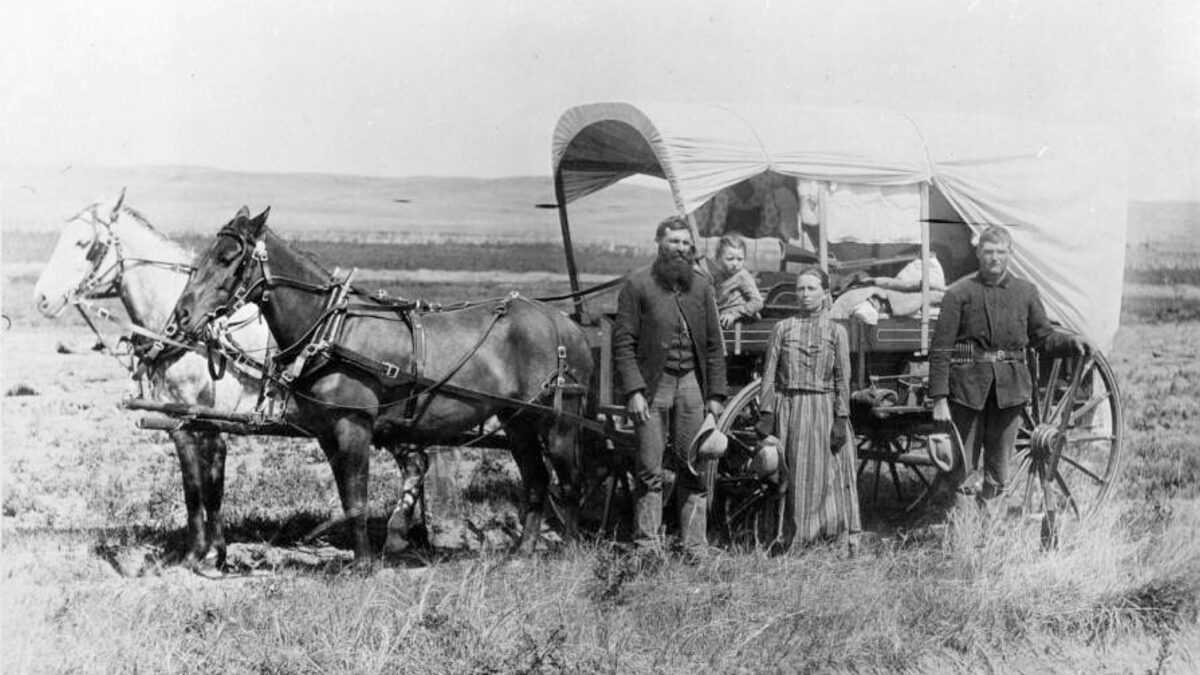
A family of settlers traveling during the Great Western Migration in 1866, almost certainly prompted by the 1862 Homestead Act. Like many others, these people may have created the factual predicate for an RS 2477 right-of-way.
This two-part article discusses the history of an old federal mining statute and explains the complexities of litigating RS 2477 claims. This part 1 provides the history of the statute and introduces common issues that arise in RS 2477 cases.
Real property is a basic form of wealth. Access is necessary to land ownership, allowing the property’s use and exploitation.1 Part 1 of this two-part article explores the complex facts and laws arising from a remnant of an old federal mining statute known as US Revised Statute 2477 (RS 2477),2 which provides that the mere use of a roadway over property when it was in the public domain creates legal recognition of public access.3 Simply by traversing a relatively defined route over what were once public lands, miners, homesteaders, ranchers, and settlers may have created a public highway that survives to this day irrespective of whether the route is still in use, or even perceptible. This article discusses only RS 2477 issues implicated by private property ownership. Part 2 will focus on typical defenses to RS 2477 claims, procedural issues that may arise in litigating public road claims involving private property, and the nuts and bolts of preparing and presenting a compelling case at trial in which one party seeks a judicial finding regarding whether the route at issue is or is not a public road, including relevant evidence.
Overview
RS 2477 is succinct: “The right of way for the construction of highways over public lands, not reserved for public uses, is granted.” Yet these few words have resulted in abundant complex,4 obscure,5 and even contradictory6 state and federal judicial decisions. The statute’s simplicity is only one factor that makes trying an RS 2477 case both challenging and interesting. Some of the issues encountered include: What, in fact or in law, are old public roads? Who owns them? Can they be judicially established for private access? How are courts interpreting RS 2477? How are public road cases involving private property best tried?
An RS 2477 trial essentially becomes a mini history lesson for the parties and court. Interlaced with the case’s factual background are the legislative history and judicial interpretation of RS 2477 and several other federal statutes allowing for public land occupation and exploitation. As with most cases, understanding the pertinent legal issues in relation to the underlying disputed facts is critical to effectively trying an RS 2477 case.
Under Colorado law, RS 2477 creates a “right-of-way” for the construction of public roads (highways) and allows for recognition of an existing “right-of-way” over land that may have no physical road features today. The statute applies to both public lands and to private property that at one time was part of the public lands. RS 2477 claims involving federal land implicate complex statutory, regulatory, and decisional law beyond this article’s scope.7 Where a historical road crosses only private property, there is ample potential for complex litigation, much to the consternation of the owners of land over which a claimant may seek access.
RS 2477’s simple language lies at the heart of the legal complexity arising from the statute, including judicial decisions and federal and state statutes and regulations. In a thoroughly researched opinion, the Tenth Circuit observed:
Unlike any other federal land statute of which we are aware, the establishment of RS 2477 rights of way required no administrative formalities: no entry, no application, no license, no patent, and no deed on the federal side; no formal act of public acceptance on the part of the states or localities in whom the right was vested.8
This marriage of a single, short statute with complex historical facts and court decisions has spawned uncertainty, and some courts have made assumptions seemingly at odds with the law without realizing it.9 This, in turn, has resulted in conflicting rulings that sometimes provide little guidance for litigators.
What Is a Road?
In the most general sense, a road is a physical feature of the ground surface that has been traversed by livestock,10 people, and/or vehicles, typically to get from one place to another. Legally, a road can exist even though it is no longer used for travel and there are no obvious surface features suggestive of a road. Such roads are “historical.” In some instances, a potential road can be evidenced by a barely noticeable feature, such as a footpath.11 There are many kinds of roads, but they can be broadly categorized as either private or public roads. Private roads cross private property and are owned outright by the land’s fee owner unless a road easement exists in favor of a third party. If the easement is private and nonexclusive, the road remains private, and its use shared.
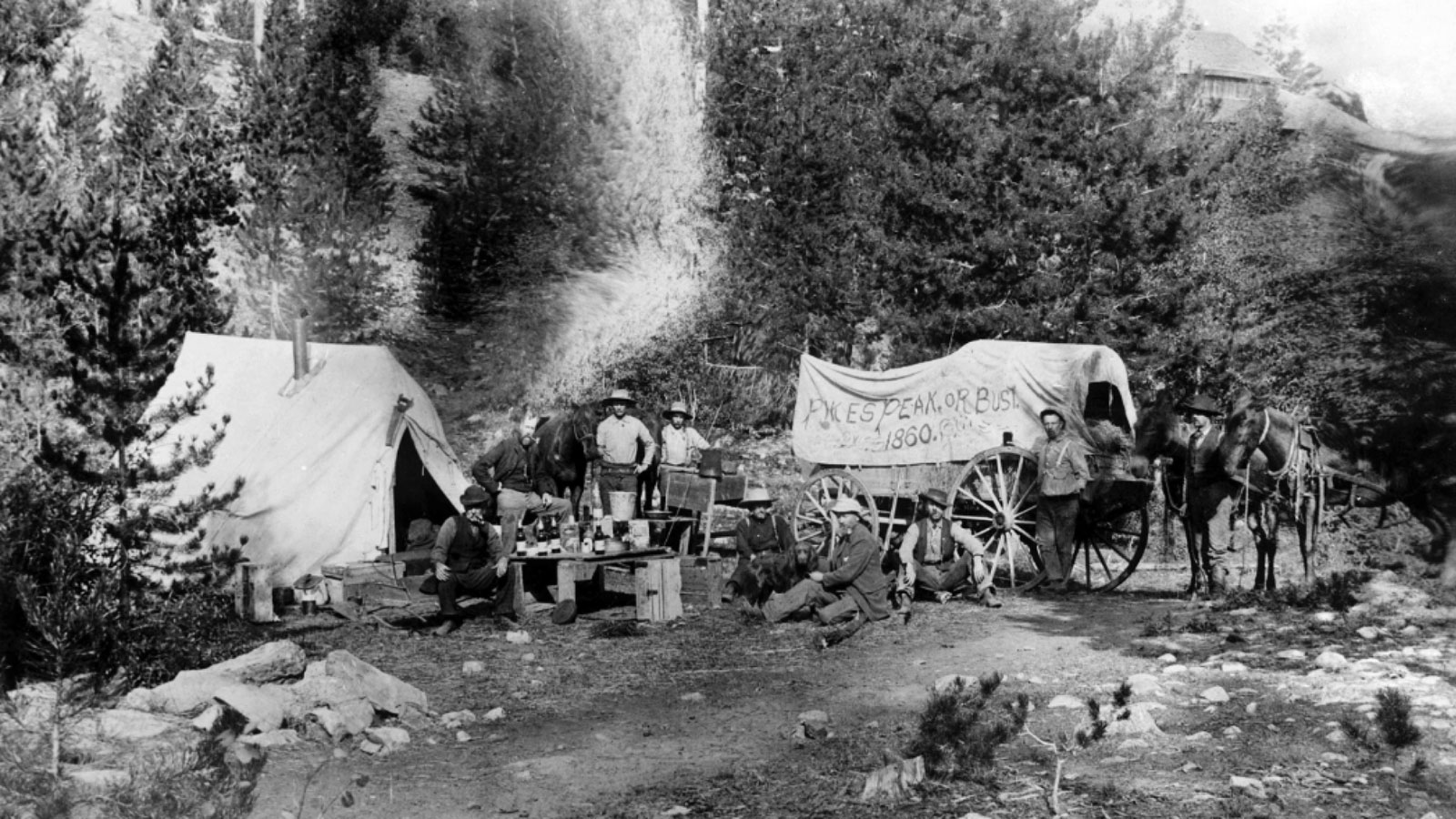
Categorizing public roads is more complex both as to ownership and use. State highways are purely statutory creatures.12 At the county level, roads are either primary or secondary.13 At the municipal level, roads are typically referred to as streets or alleys.14 This article addresses only public roads created under RS 2477 over now private lands that may or may not implicate county ownership, regulation, or control. Colorado has adopted a broad definition of what constitutes a “road or highway” under RS 2477, which may include “roads created by the passage of wagons, etc.,” and even footpaths.15 Indeed, the Colorado Supreme Court has said:
The purpose of the act was to give every settler, however unable to build a road, lawful access to whatever land he chose to enter. If access is feasible without work with pick and shovel no such work is necessary, and it would be a mistake to hold that action by any governmental authority is required.16
Who Owns Public Roads?
It is not always apparent who owns a public road. As noted above, Colorado roads can be owned by the state or by political subdivisions.17 However, not all public roads are necessarily owned by a public entity. In Colorado, it is not clear whether a public road can exist if a county neither owns nor controls any interest in it. For example, under CRS § 43-2-110, counties maintain “road rolls” and “road maps” to keep track of roadways that they own and generally maintain, but some counties also have what are regarded as public roads that are not on the road maps and, thus, are technically not claimed by a county. Also, a hybrid road like a toll road can exist. A toll road is created by statute for public use but is owned and maintained privately.18
When courts make a finding that a historical road, long in disuse, is a public road, the county isn’t required to enter the road on its maps and rolls as a county road even if the county was a party to the litigation.19 This scenario occurred in Boulder County regarding the Old Wagon Road traversing Big Horn Mountain from the historic town of Sunshine to Gold Hill.20 In that case, in which the county was a party, the trial court found that the entire segment of the Old Wagon Road, while at one time an RS 2477 road, had been abandoned by the construction and use of the “Shelf Road” around the side of the mountain. The court of appeals reversed, holding that segments of the Old Wagon Road were part of a public road. Yet, to this day, those segments—interrupted by segments of Bureau of Land Management (BLM) land—are not on the Boulder County road maps and are not maintained by the county.
One aspect of road ownership drawing ongoing attention from federal courts is the nature of a private landowner’s property rights or interests in a public road that abuts or traverses the landowner’s property. Such questions typically arise in the context of road litigation with a federal agency under the federal Quiet Title Act, 28 USC § 2409a, which waives sovereign immunity for the federal government under certain conditions.
Under federal law, even though property owners may claim an easement over public land, this “is not of such a nature to enable them to bring suit to quiet title.”21 Thus, a private party cannot sue the federal government under RS 2477 unless the subject road traverses the private party’s property and title is disputed.22 Under state law, however, the issue is not so clear. In Colorado, a county cannot, without compensation, “formally” abandon a public road if such action would deprive abutting landowners of access to their property.23 These case holdings raise important questions as to who has the right or obligation to maintain or improve such roads, and what road construction standards apply.24
Colorado courts have not answered the question as to what happens if a county has not taken any overt maintenance acts and one private party sues another for access. For example, if one property owner wants a road to be gravel, and an adjacent owner wants it to be paved, who decides? What happens if “dueling bulldozers” show up at the same time to make different improvements? And, who is liable for a badly maintained public road that has not been accepted by a county? A county has a right, but not an obligation, to maintain county roads.25 If a county has not included a public road on its road map, there may be no such right or obligation.
RS 2477: State Versus Federal Law
Both state and federal courts have addressed RS 2477 disputes arising in most western states, although there is disagreement over whether federal or state law determines the existence of an RS 2477 road.26 With so many landowners looking to the public domain to protect their interests over the past decades, there has been a considerable amount of RS 2477 litigation.
Over a century after its enactment, Congress addressed RS 2477 directly with the 1976 Federal Land Policy and Management Act,27 which repealed RS 2477 but preserved all roads established under the statute.28 In the 1990s, it then attempted, but failed, to enact legislation empowering the US Department of Interior (DOI) to regulate RS 2477 roads, before placing a moratorium on any further DOI regulation.29
In Colorado state courts, questions of whether and when the grant of a right-of-way under RS 2477 is accepted by the public are matters of state law.30 RS 2477 confers concurrent jurisdiction, though applicable substantive law depends on the issue in question. For example, in Colorado, state law applies to some issues, such as what constitutes “acceptance,” while federal law interprets the statutory language.
The Colorado Supreme Court has said:
The sum of our holdings is that the statute is an express dedication of a right-of-way for roads over unappropriated government lands, acceptance of which by the public results from use by those for whom it was necessary or convenient. It is not required that work shall be done on such a road, or that public authorities shall take action in the premises.31
While federal law governs RS 2477’s interpretation, in deciding what is necessary for acceptance of a right-of-way under the statute, “federal law ‘borrows’ from long-established principles of state law to the extent that state law provides convenient and appropriate principles for effectuating congressional intent.”32 However, for purposes of federal law, in High Lonesome Ranch v. Board of County Commissioners, the Tenth Circuit recently modified this view with regard to acceptance of the grant by the public when it rejected Colorado’s more lenient standard.33
Public Lands Not Eligible for RS 2477 Rights-of-Way
A number of federal statutes besides RS 2477 may be relevant when litigating under RS 2477. Statutes that provide for federal reservation of land from the public domain, or the withdrawal of public land by private parties such as miners and homesteaders, can render land not susceptible to judicial recognition of a road as a public road under RS 2477 if the road was “constructed” after a reservation or withdrawal.
Federal laws enabled early pioneers to enter and exploit the public domain in ways that left a physical and documentary trail of evidence that modern-day litigators can use to more effectively prosecute or defend RS 2477 cases. In the West, particularly in Colorado, most of the land now privately owned was once part of the public domain and owned by the US government, administered initially by the General Land Office (GLO) and later by the BLM.
In the mid-19th century, travel over the public domain was not regulated. Land was not considered scarce, and disposal of federal land was viewed as a means of resource extraction, economic development, and settlement.34 Thus, in 1862, Congress passed the Homestead Act,35 allowing farmers and ranchers to make claim to various sized parcels in the public domain for agriculture and grazing.
In 1866, in a further effort to expand the nation’s economy and normalize the burgeoning mining industry, Congress passed the 1866 Mining Law (the 1866 Act),36 which legitimized the then-existing business practices of miners and their associations who, until then, were essentially trespassers on public land with no legal right to remove minerals. The 1866 Act authorized the issuance of mineral patents on public land and recognized the power of claim associations that had been created by miners in an act of self-regulation before governmental intervention. The 1866 Act did more, however, as it also legally recognized existing roads, irrigation ditches, and reservoirs, granting amnesty for these uses and authorizing such uses through patents and grants. RS 2477 was part of the 1866 Act. Congress passed the more comprehensive General Mining Law of 1872,37 but left in place most of the features of the 1866 Act, including recognition of rights-of-way and roads.38
The court in Southern Utah Wilderness Alliance v. Bureau of Land Management (SUWA) considered in depth what constitutes a “reservation” of public land under RS 2477 and whether a withdrawal—in that case, a coal withdrawal—was the same thing.39 SUWA provides a somewhat technical reading and resulting framework in answering the “reservation” question under RS 2477. In concluding the two terms—withdrawal and reservation—were not the same for purposes of RS 2477, the court said that a reservation “not only withdraws the land from the operation of the public land laws, but also dedicates the land to a particular public use.”40
National Forest Reserves
Federal legislation creating forest reserves is also relevant to many RS 2477 disputes, as the creation of a reserve removed that land from the public domain for the statute’s purposes. If a disputed road was created after a forest reserve was established, it would not be considered to have been constructed over the public domain. The 1891 Forest Reserve Act41 was the first statute authorizing the president to set aside from the public domain tracts of federally owned forests under the GLO’s authority. The US Forest Service was established by Congress in 1905 during Theodore Roosevelt’s presidency, at the height of the Progressive Movement. At that time, existing forest reserves became national forests under the US Forest Service as part of the Department of Agriculture.42 Most of the national forests in Colorado were created by President Roosevelt between 1904 and 1908.43
American Indian Reservations
One form of reservation from the public domain is the American Indian reservation. There are only two remaining Indian reservations in Colorado, the Southern Ute Indian Reservation and the Ute Mountain Ute Reservation. The issue of an RS 2477 right-of-way on Indian land has not been litigated extensively, largely in part because of judicial deference to federal reservations and Indian title as set out in United States v. Santa Fe Pacific R.R.44 One Colorado federal case involved the former Ute Indian Reservation, parts of which had been withdrawn from the public domain, thus making much of the reservation land unavailable for non-Native consumption.45
The size of the Ute Indian Reservation was drastically reduced after the Meeker Incident. The Colorado Encyclopedia describes the incident as follows:
The Meeker Incident (September 29–October 5, 1879) was a Ute uprising at the White River Indian Agency on the Ute Reservation in present-day Rio Blanco County. Tension had been building on the reservation for months as Indian Agent Nathan Meeker attempted to force the Utes to change their traditional ways of life. On September 29, the Utes revolted, killing Meeker and ten others, and taking Meeker’s family hostage. The violence ended on October 5, when reinforcements relieved US cavalry pinned down by Ute gunfire at nearby Milk Creek.46
Following the Meeker Incident, the Hayes administration negotiated the 1880 Ute Agreement, which Congress ratified on June 15, 1880, transferring most of the Ute Indian Reservation in Colorado to the United States and paving the way for the land to be homesteaded.47

Economically, the opening of most of the former Ute Indian Reservation accelerated ranching, homesteading, mining, and land development across western Colorado. Socially, it produced a profound demographic shift by removing most of the Utes from their Colorado homelands and replacing them with settler communities, local governments, and a private economy that persists today.
Homestead Patents
Another way to remove land from the public domain was to “enter” the public land pursuant to the Homestead Acts.48 The original Homestead Act was revised several times, first by the Timber Culture Act (1873)49 and later by the Desert Land Act (1877),50 the Timber and Stone Act (1878),51 the Organic Administration Act of 189752 (creating the forest reserves), the Enlarged Homestead Act (1909),53 the Stock-Raising Homestead Act (1916),54 and finally, the Taylor Grazing Act (1934).55 The entry records and patent applications under these laws allow for removal of land from the public domain for purposes of finding RS 2477 inapplicable, and they provide a chronicle of dates and activities that can be admitted into evidence to help establish the existence and use of a disputed public road over property.
Mineral Patents
Yet another way to withdraw land from the public domain was entry pursuant to the General Mining Law of 1872. Once mineral entry is made,56 land ceases to be a part of the public domain subject to RS 2477, provided a patent is ultimately issued to the claimant.57 Like homestead patents, mining claim patents can often provide relevant historical information not only for the claim itself, but also for the existence or nonexistence of a road leading to and over the public domain. For example, mining regulations required that patent applications include mineral surveys, which were required to show the existence of a road feature if it crossed any claim boundaries. Such surveys may have great evidentiary value because they may reflect the existence or absence of a road feature as of a specific date.
Ditch Company Entry
The 1866 Act also provided for land preemption by ditch and reservoir construction.58 Access rights accompany the creation of ditches and reservoirs. Ditch rights-of-way include the right to construct an access road for ditch construction, operation, and maintenance.59 Ditch companies would either construct a new road or improve an existing road over the public domain for the ditch. The history of the ditch access road’s use may be relevant to the existence of an RS 2477 road.
CRS § 37‑86‑102 is a state water right statute, grounded in Colorado’s constitution and early territorial statutes, not federal land law. The Colorado statute does not derive its authority from federal law, and the operative federal statutes, 43 USC §§ 946–950, were not codified in CRS § 37‑86‑102. Instead, both laws reflect parallel but independent legal regimes addressing water access rights—one federal (public lands), one state (Colorado water rights).
Colorado courts rely on Article XVI, § 7 of the Colorado Constitution and Colorado statutes, CRS §§ 37‑86‑102 and ‑104, rather than federal law, 43 USC §§ 946–950, where a dispute concerns private lands between private parties, even if the ditch was historically associated with federal land.60
A ditch company’s use of a road to build its reservoirs and ditches does not constitute a withdrawal from the public domain or entry of land because the ditch company is not entitled to any interest in that land, as its ditch and attendant roads constitute only easements.61 A ditch company’s legal or equitable rights to the land over or through which the ditch is dug do not vest against the government until the ditch is completed.62 Also, if a ditch company asserted some right in a particular road that affected the general public’s ability to accept an RS 2477 grant, those rights would not have vested until its ditches were completed.63
The use of a disputed route to access and construct ditches and reservoirs is evidence of the use of a public road in the same way a settler’s use of a road to reach a homestead patent constitutes public use. A ditch company’s use of a road over public land is one kind of access that RS 2477 contemplated and the government explicitly encouraged.64
Operation of RS 2477
A primary element of proof in an RS 2477 case is the date of “construction” of the road relative to when the affected land was removed from the public domain, whether by way of reservation, withdrawal, conveyance, or otherwise. Where some of the property implicated by a lawsuit is public land, the federal or state government must be a party to the dispute.65
Access
One of the most common issues in an RS 2477 dispute is access. Access to land in Colorado that was once remote from development has become an increasingly contentious issue. Contributing factors include increasing land values, amplified emphasis on privacy and private property rights, changes in property ownership, and growing use and development in rural and remote areas.
Access disputes among neighboring property owners are often triggered by locked gates through which property owners must travel to access their respective properties. Or, disagreements can arise over access to a mining claim that now may be surrounded by land owned and used by others. Establishing that a road or trail both existed and was used before the date the land it traverses was removed from the public domain—by reservation or patent, for example—is vital to a successful RS 2477 claim.
Grant of Right-of-Way
Apart from RS 2477’s ostensibly simple language, one difficulty plaguing RS 2477 disputes is that the statute was self-effectuating and did not require that a proponent of a public road make application or record a right-of-way. In Colorado, “[q]uestions of whether and when the grant of a right-of-way is accepted by the public are matters of state law. There are no statutorily prescribed state or federal procedures or requirements for accepting a right-of-way granted by the United States under RS 2477.”66 RS 2477 was unique in that the establishment of RS 2477 rights-of-way required no administrative formalities.67
Entry
RS 2477 rights-of-way could be established only over “public lands, not reserved for public uses.”68 To preclude the establishment of an RS 2477 right-of-way, it is necessary to show that the land it first crossed was not in the unreserved public domain at the time. Withdrawal of public land could also be made by entry under other statutes such as the homestead and mining statutes, as discussed above. Colorado courts have discussed what is necessary to effect an “entry” under RS 2477. For example, a homesteader’s entry “is made by making and filing an affidavit and paying the sum required by law, [and] is a contract of purchase which gives him an inchoate title to the land, which is property.”69
“Construction” of a Road Under RS 2477
The term “construction” as used in RS 2477 does not have the same meaning generally ascribed to it in today’s language. “Actual construction” is not necessary; mere “use” may suffice.70
Acceptance of Public Grant
A requisite element of an RS 2477 claim is that the subject road must have been “constructed” over the “public domain.” The terms “public domain” or “public lands” mean that the lands are or were subject to the public land laws of the United States, and include land initially acquired by the United States by cession, purchase, and treaty, as well as lands acquired by other methods where the latter have been expressly declared by Congress to be public lands or public domain.71 Public domain lands are defined by the DOI as “‘[o]riginal public domain lands that have never left Federal ownership; also, land[s] in Federal ownership that were obtained by the Government in exchange for public domain lands or for timber on public domain lands.’”72
In Colorado, RS 2477 serves as “an express dedication of roads over public land where the roads were established by public use.”73 The requisite use must be established before the land at issue is withdrawn from the public domain or included within a reserve.74
Public Road Litigation Between Private Parties
As will be discussed in part 2’s exploration of standing questions, uncertainty concerning standing and joinder of indispensable parties raises serious questions when litigating RS 2477 cases. For example, questions could arise as to possible collusion between parties who sue each other as to a stretch of roadway where the legal status of the section has not been determined. The “outcome” may have been agreed to before the case commences. Parties can effectively “throw” the case by one party not litigating aggressively if the court does not require the joinder of additional parties with potentially adverse interests, such as a county government. Arguably, a judgment entered in a suit between “cooperating” parties may be dispositive as to the road’s status. If the parties want to make the lawsuit outcome nearly bulletproof, the losing party could file an appeal and then effectively concede the result on appeal. Indeed, there are a few road cases involving only private parties with a resulting declaration that a particular road is public or not.75 While there is no evidence that the parties to these particular actions conspired in the result, the opportunity to do so was present.
This potential for lawsuit abuse may demand the joinder of a local county as a necessary party to ensure the procedure’s fairness, assuming that the county is not politically predisposed to a certain result. However, even without such a predisposition, there may be practical reasons a county would seek a particular result.76 As noted above, unbeknownst to many, there are public roads that are not formally part of any federal, state, or county road systems. Because roads owned or controlled by a governmental entity may require that maintenance,77 a county may choose not to assume ownership of or control over, and responsibility for, a public road.78
In Heath v. Parker,79 following remand, the district court declared only parts of the road to be a public road. Presumably, the private property traversed by the Old Wagon Road is comprised of noncontiguous mining claims, the intervening areas constituting BLM land. Because the BLM was not a party to the lawsuit, presumably it is not bound by the court’s declaration. There may be short segments of the Old Wagon Road that are public roads but that Boulder County has not made part of its road system. This raises the question discussed above as to who has the right or obligation to maintain or improve such roads.
Conclusion
The complex facts and laws arising from the old federal mining statute RS 2477 provide fertile ground for exploration of ancient records and the history books in an effort to give meaning to and apply this important law. Legal recognition of public access by the mere use of a roadway across property at a time when the land was still in the public domain has led to developing federal and state case law. Perhaps without fully anticipating the legal ramifications of their actions, miners, homesteaders, ranchers, and settlers may have created a public highway that survives to this day regardless of whether the route is still in use or visible.
A properly presented RS 2477 case can establish whether an RS 2477 road exists, thereby settling important land and access rights. Part 2 will assist lawyers in preparing an effective RS 2477 case. It will also illustrate why so many judges are intrigued by RS 2477 litigation due to the cases’ historical grounding in the “Old West,” and their attendant legal challenges in light of this still developing body of law.
Explore This Issue

Frank Plaut
In Memoriam

Related Topics
Notes
citation Robinson, “Public Roads on Private Lands in Colorado—Part 1: An RS 2477 Litigation Primer,” 55 Colo. Law. 36 (Nov. 2026), https://cl.cobar.org/features/public-roads-on-private-lands-in-colorado.
1. Access has been described as one of the “bundles of sticks” of land ownership. Heath v. Parker, 30 P.3d 746, 750 (Colo.App. 2000), cert. denied, No. 01SC96, 2001 Colo. LEXIS 771 (Sept. 17, 2001). The author served as lead counsel for Parker in Heath.
2. Originally titled An Act Granting the Right of Way to Ditch and Canal Owners over the Public Lands, and for Other Purposes (1866) (1866 Act), § 8, 14 Stat. 251, 253 (codified at 43 USC § 932 and repealed by the Federal Land Policy Management Act of 1976, Pub. L. No. 94–579 § 706(a), 90 Stat. 2793). The 1866 Act is sometimes referred to as the Mining Act of 1866 or the Act of July 26, 1866. Although Congress repealed RS 2477, the Federal Land Policy Management Act preserved any rights-of-way that existed before October 21, 1976. 43 USC § 1769(a).
3. CRS § 43-2-201 is Colorado’s parallel to RS 2477 and provides that “the following are declared to be public highways: . . . (e) All roads over the public domain, whether agricultural or mineral.” In addition, CRS § 43-1-202 provides that “[a]ll roads and highways which are, on May 4, 1921, by law open to public traffic shall be public highways within the meaning of this part 2.”
4. San Juan County v. United States, 503 F.3d 1163 (10th Cir. 2007); Utah Wilderness Soc’y v. Kane County, 581 F.3d 1198 (10th Cir. 2009), vacated and remanded, 632 F.3d 1162 (10th Cir. 2011) (en banc).
5. See, e.g., S. Utah Wilderness All. v. Bureau of Land Mgmt., 425 F.3d 735 (10th Cir. 2005) (hereinafter SUWA).
6. Compare Heath, 30 P.3d at 750, and LeSatz v. Deshotels, 757 P.2d 1090 (Colo.App. 1988), with Mason v. State, 656 P.2d 465 (Utah 1982). See generally Howell v. King County, 134 P.2d 80 (Wash. 1943) (private easement in way vacated, abandoned, or closed by public).
7. See SUWA, 425 F.3d at 761.
8. Id. at 741. The Tenth Circuit also observed, in understatement: “The language is short, sweet, and enigmatic: ‘And be it further enacted, that the right of way for the construction of highways over public lands, not reserved for public uses, is hereby granted.’ There is little legislative history.” Id. at 761.
9. For example, until 2012, the Colorado Supreme Court rendered decisions on RS 2477 cases between private parties without joining any governmental entity. However, inasmuch as the joinder issue was not raised on appeal, those cases cannot be deemed dispositive precedent. Merrifield v. Bd. of Cnty. Comm’rs, 654 F.3d 1073, 1084 (10th Cir. 2011) (“[A]n opinion is not binding precedent on an issue it did not address.”), cited with approval in Town of Vail v. Reggie D. Delponte Residence Tr. No. 1, No. 22CA0819, 2023 WL 12058992 (Colo.App. June 1, 2023) (unpublished). Nevertheless, these cases have been cited many times without addressing the issue as to the necessity of joining a governmental entity. See, e.g., Brown v. Jolley, 387 P.2d 278, 281–82 (Colo. 1963); Rozman v. Allen, 68 P.2d 440 (Colo. 1937); Dunbar v. Kohler, 180 P. 739 (Colo. 1919).
10. See, e.g., Lovvorn v. Salisbury, 701 P.2d 142, 144–45 (Colo.App. 1985) (cattle and livestock).
11. See Simon v. Pettit, 687 P.2d 1299, 1303 (Colo. 1984), cited in Heath, 30 P.3d at 750, for the proposition that “depending on the context, a footpath may be considered a highway,” though in Simon, the Colorado Supreme Court held that, where a footpath traversed private property in an urban setting, the use was deemed permissive and did not establish a public highway under a state statute.
12. See CRS §§ 43-2-101 et seq.
13. See CRS §§ 43-2-108, -109.
14. See CRS § 43-2-123; CRS § 31-23-107.
15. Heath, 30 P.3d at 750 (citing Simon, 687 P.2d 1299, and Cent. Pac. Ry. v. Alameda County, 284 U.S. 463, 467 (1932)).
16. Nicolas v. Grassle, 267 P. 196, 197 (Colo. 1928) (analyzing RS 2477 and finding that the road in question was in use before the defendants’ entry into the land and was therefore a public road). See also Rozman, 68 P.2d 440 (public road claim based on use to drive cattle back and forth to nearby mountain ranges).
17. “‘Political subdivision’ means a county, city and county, city, town, service authority, school district, local improvement district, law enforcement authority, city or county housing authority, or water, sanitation, fire protection, metropolitan, irrigation, drainage, or other special district, or any other kind of municipal, quasi-municipal, or public corporation organized pursuant to law.” CRS § 29-1-202(2).
18. CRS § 43-2-201(1)(d). See Estes Park Toll-Road Co. v. Edwards, 32 P. 549, 550 (Colo.App. 1893).
19. Cf. McIntyre v. Bd. of Cnty. Comm’rs, 86 P.3d 402, 413–14 (Colo. 2004) (“The strongest indicator of county’s claim of right is the inclusion of the road on the county road system and the expenditure of public funds for maintaining the road.”); Collins v. Ketter, 719 P.2d 731, 733–34 (Colo.App. 1986) (“[T]here was no acceptance of the offer of dedication either by the general public or public authorities within a reasonable time. The Boulder County Commissioners have never accepted the dedication, nor has the county ever maintained or repaired the road.”).
20. Heath, 30 P.3d at 751.
21. See Fairhurst Family Ass’n v. U.S. Forest Serv., 172 F.Supp.2d 1328, 1331 (D.Colo. 2001) (holding that owner had no real property interest in alleged right-of-way created in public road as required for owner to bring quiet title action under federal Quiet Title Act (citing Kinscherff v. United States, 586 F.2d 159, 161 (10th Cir. 1978))).
22. See Kane County v. United States, 597 F.3d 1129, 1133 (10th Cir. 2010). See also High Lonesome Ranch v. Bd. of Cnty. Comm’rs, 61 F.4th 1225, 1237–38 (10th Cir. 2023); Alaska National Interest Land Conservation Act (ANILCA), requiring secretary of agriculture to provide access to non-federally owned land within boundaries of national forest system as secretary deems adequate to secure owner’s reasonable use and enjoyment; since ANILCA’s reach was nationwide, it also applied to national forest lands outside Alaska. 16 USCA § 3210(a); 36 CFR §§ 251.111 et seq.
23. Heath, 30 P.3d at 750 (access is one of the bundle of sticks of property ownership). Note that CRS § 43-2-303(2)(a) was cited in Heath; under subsection (2)(f), abandonment is not included as a formal vacation without proper documentation: “If any roadway is vacated or abandoned, the documents vacating or abandoning such roadway shall be recorded pursuant to the requirements of [CRS §] 43-1-202.7.”
24. See Martino v. Fleenor, 365 P.2d 247, 250 (Colo. 1961) (fact that county on some occasions did maintenance work on roadway was not sufficient to make section line road a public highway).
25. CRS §§ 43-2-109, -110. See Wibby v. Bd. of Cnty. Comm’rs, 409 P.3d 516, 523 (Colo.App. 2016) (private subdivision landowners lacked standing to sue county to force road maintenance).
26. Compare Brown, 387 P.2d 278 with High Lonesome Ranch, 61 F.4th 1225.
27. 43 USC §§ 1701 et seq.
28. 43 USC § 1769(a). “[RS 2477] remained in effect for 110 years, and most of the transportation routes of the West were established under its authority. During that time congressional policy promoted the development of the unreserved public lands and their passage into private productive hands; R.S. 2477 rights of way were an integral part of the congressional pro-development lands policy.” SUWA, 425 F.3d at 740–41.
29. See generally Freeman and Ro, “RS 2477: The Battle Over Rights-of-Way on Federal Land,” 32 Colo. Law. 105 (Oct. 2003).
30. Camp Bird Colo., Inc. v. Bd. of Cnty. Comm’rs, 215 P.3d 1277, 1284 (Colo.App. 2009) (citing Barker v. Bd. of Cnty. Comm’rs, 49 F.Supp.2d 1203, 1214 (D.Colo. 1999)). In Camp Bird, the court’s analysis treated county declarations (formal governmental acceptance) and public use as two independent alternative methods of accepting the federal grant.
31. Leach v. Manhart, 77 P.2d 652, 653 (Colo. 1938).
32. SUWA, 425 F.3d at 768.
33. In High Lonesome Ranch, for purposes of federal law, the Tenth Circuit rejected Colorado’s standard for acceptance in Brown, which held that such acceptance “results from ‘use by those for whom it was necessary or convenient’” and suffices even “if the use be by only one.” High Lonesome Ranch, 61 F.4th at 1245 (citing Brown, 387 P.2d at 281). Applying this for Colorado, the Tenth Circuit cited San Juan County v. United States, 754 F.3d 787 (10th Cir. 2014), in which the Tenth Circuit held that “[n]either R.S. 2477 nor Utah law requires any ‘administrative formalities’ or ‘formal act of public acceptance’ of the right-of-way. Accordingly, disputes involving R.S. 2477 rights-of-way often require a close examination of historical evidence of public use.” San Juan County, 754 F.3d at 791 (citations omitted). The court in San Juan County concluded that “[t]he intensity of public use remains a pertinent component in determining the existence of a public thoroughfare. The district judge did not err in considering it.” Id. at 799.
34. See generally Blumm and Erickson, “Federal Wild Lands Policy in the Twenty-First Century: What a Long, Strange Trip It’s Been,” Colo. Nat. Res., Energy & Env’t L. Rev. (2014).
35. 1862 Homestead Act, 12 Stat. 392; 1877 Desert Land Act, ch. 107, 19 Stat. 377 (codified as amended at 43 USC §§ 321–323).
36. 1866 Act, supra note 2, ch. 262, 14 Stat. 251.
37. General Mining Law of 1872, Act of May 10, 1872, 17 Stat. 91 (1872) (codified as amended at 30 USC §§ 22 et seq.).
38. Section 8 of the 1866 Act was recodified as RS 2477 under the General Mining Law of 1872.
39. SUWA, 425 F.3d 735.
40. Id. at 784 (finding that government’s withdrawal of 5.8 million acres in Utah from settlement, location, sale or entry, but reserving for coal extraction, was not a reservation precluding the public’s establishment of an RS 2477 right-of-way across those lands; lands subject to the coal withdrawal remained public lands that are “not reserved for public uses” and, thus, the public could establish an RS 2477 right-of-way across them after the coal withdrawal).
41. Forest Reserve Act of 1891, 26 Stat. 1103 (1891) (codified as amended at 16 USC § 471 (1958)).
42. Transfer Act of 1905, ch. 288, 33 Stat. 628 (codified at 16 USC § 472 (1970)).
43. US Department of Agriculture, Forest Service, Establishment and Modification of National Forest Boundaries: a Chronological Record 1891–1973 (Oct. 1973). Some of these national forests were created from national forest reserves. For example, the Medicine Bow National Forest dates back to May 22, 1902, with the establishment of the Medicine Bow Forest Reserve by President Theodore Roosevelt. The Roosevelt National Forest, originally part of the Medicine Bow Forest Reserve, was first named the Colorado National Forest in 1910. In 1932, President Herbert Hoover renamed the forest to honor President Theodore Roosevelt.
44. United States v. Santa Fe Pac. R.R., 314 U.S. 339 (1941).
45. High Lonesome Ranch, LLC v. Bd. of Cnty. Comm’rs, 508 F.Supp. 3d 801, 833 (D.Colo. 2020), aff’d in part and rev’d in part, High Lonesome Ranch, LLC v. Bd. of Cnty. Comm’rs, 61 F.4th 1225. The history of the Ute Indian Reservation described in High Lonesome Ranch is not quite accurate. The White River, Yampa, Grand River, and Uncompahgre Utes were removed to what is now Utah. The Southern Ute bands remained in southwestern Colorado on a much smaller reservation, which is today the Southern Ute Indian Reservation and Ute Mountain Ute Reservation. Colorado Encyclopedia, “Meeker Incident,” https://coloradoencyclopedia.org/article/meeker-incident.
46. “Meeker Incident,” supra note 45.
47. Id.; Tribal Treaties Database, “Agreement With the Confederated Bands of Ute, 1880,” https://treaties.okstate.edu/treaties/agreement-with-the-confederated-bands-of-ute-1880-22300.
48. See, e.g., Lee v. Masner, 45 P.3d 794, 795 (Colo.App. 2001) (critical date was when property was removed from public domain, which was date of homesteader’s entry). Under the Homestead Act of 1862, a registration of entry form was filed upon actual entry, with a certificate of entry issued five years later, which provided the right to obtain a patent, upon which the date of withdrawal is the date of actual entry.
49. Timber Culture Act, ch. 277, 17 Stat. 605 (1873).
50. Desert Land Act, ch. 107, 19 Stat. 377 (1877) (codified as amended at 43 USC §§ 321–323).
51. Timber and Stone Act of 1878, ch. 151, 20 Stat. 89 (1878).
52. Organic Administration Act of 1897, 16 USC §§ 475–482, amending the Forest Reserve Act of 1891, ch. 561, 26 Stat. 1095, 1103, to empower the president to modify national forest reservations.
53. Enlarged Homestead Act, ch. 160, 35 Stat. 639 (1909) (codified at 43 USC §§ 218–221) (repealed 1976).
54. Stock-Raising Homestead Act (codified at 43 USC §§ 291–302), repealed by the Federal Land Policy and Management Act of 1976, 90 Stat. 2743, 2789, § 7 (codified at 43 USC §§ 1701–1782 (1976)).
55. 1934 Taylor Grazing Act, 48 Stat. 1269 (codified at 43 USC §§ 315 et seq.).
56. Mineral entry under the General Mining Law of 1872 requires that a valuable or marketable mineral was found; the claim was staked by monuments and a notice of claim posted; a “location certificate” was prepared and recorded with the county clerk and recorder and also filed with the GLO, now the BLM. BLM, “Locatable Minerals (Hardrock and Placer Mining),” https://www.blm.gov/programs/energy-and-minerals/mining-and-minerals/locatable-minerals; 43 CFR groups 3700 and 3800.
57. See, e.g., Barker, 49 F.Supp.2d at 1215 (“once [mineral] entry is made and certificate is delivered, land ceases to be a part of the public domain” and “a patent, when issued, relates back to the date of the inception of the rights of the patentee in the land” (citations omitted)).
58. “The Act of July 26, 1866, 14 Stat. 251, R.S. § 2339 declared the mining lands free and open to preemption and included the following: ‘That whenever, by priority of possession, rights to the use of water for mining, agricultural, manufacturing, or other purposes, have vested and accrued, and the same are recognized and acknowledged by the local customs, laws, and the decisions of courts, the possessors and owners of such vested rights shall be maintained and protected in the same; and the right of way for the construction of ditches and canals for the purposes aforesaid is hereby acknowledged and confirmed: Provided, however, That whenever, after the passage of this act, any person or persons shall, in the construction of any ditch or canal, injure or damage the possession of any settler on the public domain, the party committing such injury or damage shall be liable to the party injured for such injury or damage.’” United States v. Gerlach Live Stock Co., 339 U.S. 725, 747–48 (1950) (internal citation omitted).
59. 43 USC §§ 946–950.
60. See Roaring Fork Club, L.P. v. St. Jude’s Co., 36 P.3d 1229 (Colo. 2001) (not addressing 43 CRS § 946 granting ditch rights-of-way when deciding ditch rights on private land).
61. CRS §§ 37-86-102, -103.
62. Bear Lake & River Waterworks & Irrigation Co. v. Garland, 164 U.S. 1, 12 (1896).
63. CRS §§ 37‑86‑102, -103; Yunker v. Nichols, 1 Colo. 551 (1872); In re Turkey Canon Ranch Ltd. Liab. Co., 937 P.2d 739, 748 (Colo. 1997).
64. See SUWA, 425 F.3d at 786, (“Indeed, because R.S. 2477 provided one of the most important means of establishing access to homestead, desert-land, and mining claims, it would make little sense for Congress to open public lands to private claims but forbid settlers to construct highways to access those claims.”).
65. However, private parties generally don’t have standing to sue the federal government under RS 2477 and the federal Quiet Title Act unless the disputed roadway traverses both private and public lands. Fairhurst Family Ass’n, 172 F.Supp.2d at 1332 (citing Kinscherff, 586 F.2d at 161).
66. Camp Bird, 215 P.3d at 1283 (citations omitted). In 1938, an early DOI regulation was published dealing with RS 2477 rights-of-way. It provided that “this grant becomes effective upon the construction or establishing of highways, in accordance with the state laws, over public lands not reserved for public uses. No application should be filed under the act, as no action on the part of the Federal Government is necessary.” US Department of Interior, Report to Congress on R.S. 2477 at 20 (June 1993); Camp Bird, 215 P.3d at 1284 (no federal or state statutory procedures or requirements for accepting a grant under RS 2477).
67. SUWA, 425 F.3d at 741.
68. Id. at 784.
69. Lee, 45 P.3d at 796.
70. See Wilkenson v. Dep’t of Interior, 634 F. Supp. 1265, 1272 (D.Colo. 1986) (citing Leach, 77 P.2d at 653).
71. See generally Camp Bird, 215 P.3d at 1283 (citing 1 Rocky Mountain Mineral Law Foundation, American Law of Mining § 3.02[3], at 3–5 (2d ed. 2008)).
72. Id.
73. Lee, 45 P.3d at 795.
74. Barker, 49 F.Supp.2d at 1214. See also Korf v. Itten, 169 P. 148, 150–51 (Colo. 1917).
75. See, e.g., Brown, 387 P.2d at 281–82; Bowen v. Turgoose, 314 P.2d 694 (Colo. 1957); Rozman, 68 P.2d 440; Dunbar, 180 P. 739.
76. But see McIntyre, 86 P.3d at 413–14.
77. See, e.g., CRS § 24-10-106(1)(d) (“Sovereign immunity is waived by a public entity in an action for injuries resulting from . . . [a] dangerous condition of a public highway, road, or street which physically interferes with the movement of traffic on the paved portion, if paved, or on the portion customarily used for travel by motor vehicles, if unpaved, of any public highway, road, street, or sidewalk within the corporate limits of any municipality . . . or of any highway which is a part of the state highway system on that portion of such highway, road, street, or sidewalk which was designed and intended for public travel or parking thereon.”).
78. Wibby, 409 P.3d 516, does not resolve this issue as the case was dismissed based on lack of standing.
79. Heath, 30 P.3d 746. The court of appeals appears to have not considered LeSatz, 757 P.2d at 1093, which states that, where a public road is abandoned or vacated, the law imposes a private easement in favor of an owner whose property would be deprived of access by the abandonment or vacation.