


How to Use Court Websites Like a Law Librarian
Tools and Tactics for Using Colorado’s Court Websites for Legal Research
April 2026
Download This Article (.pdf)
A state court website may seem like little more than a repository of basic information or a place to complete routine tasks. A layperson might use one to find a form, look up a phone number, or check court closures, while a practitioner might log on to e-file a document or review a docket. Law librarians, however, see these sites differently—as portals to a rich research environment containing overlooked authority, valuable background materials, and other legal research tools.
The Colorado Judicial Branch’s website is a good example. More than just a landing page for the state’s judicial branch, it serves as a gateway to the state’s entire judicial system, including its courts, probation office, programs, and other public resources. Its menus provide access not only to judicial opinions but also to statutory and administrative law. The site also makes statistics, policies, and reports readily available and easy to access. Even self-help materials intended for laypeople can be valuable to practitioners, offering efficient access to relevant primary authority during legal research.
This article offers a guided tour through parts of the Colorado Judicial Branch’s website with an eye toward research value. It highlights sources a law librarian might find on this website, explains how to evaluate these sources for reliability, and shares practical tactics for making sure they are current. If you’re a practitioner, the most reliable research resources in Colorado may already be open in your browser—you just need to learn how to use them like a law librarian.
The Colorado Judicial Branch Website: An Overview
All Colorado government websites are required by law to comply with Web Content Accessibility Guidelines (WCAG) 2.1.1 These standards require sites to be perceivable, operable, and robust—meaning users can see and navigate the content, interact with it predictably, and rely on it to work with assistive technologies now and in the future.2 While designed to ensure access for users with disabilities, these guidelines also improve usability for all visitors. The Colorado Judicial Branch website reflects this approach through its use of plain language, which helps users quickly find what they need, understand it the first time they encounter it, and use it effectively to meet their goals.3
FIGURE 1. The Colorado Judicial Branch website’s main search bar at https://www.coloradojudicial.gov.

Regardless of technical skill, knowledge, or experience, both nonlawyers and seasoned practitioners alike should be able to navigate the Colorado Judicial Branch’s website with ease and find information that meets their specific needs. Its plain-language structure serves as a clear roadmap, guiding users to the resources they seek and enabling them to complete necessary tasks efficiently. Where appropriate, the site incorporates intentional redundancies, allowing users with different goals or preferences to follow different paths to reach the same destination.
Members of the public, including self-represented litigants, can easily access dockets directly from the home page beneath the welcome message and main search bar. The docket search section prominently features the question, “How do I find my court date?” above the button linking to the advanced search page, clearly indicating its purpose.
FIGURE 2. Docket Search at https://www.coloradojudicial.gov.
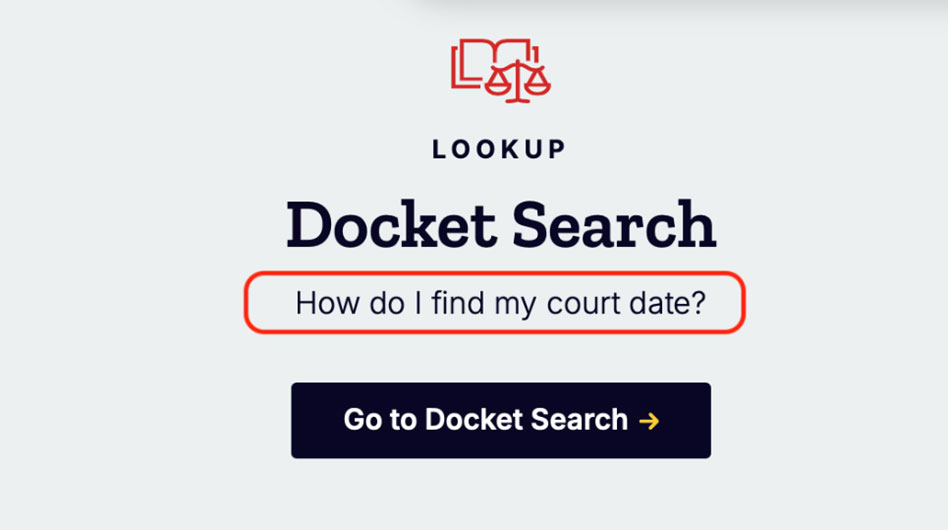
Practitioners—who could be looking for docket for any number of reasons—can access the same page through the “Public Access” menu at the top of the home page. From this dropdown, they may also navigate to the “E-Filing for Attorneys” and “Information for Attorneys” sections. Although a practitioner could use the home page docket search link for convenience, the site’s structure reflects a deliberate design that distinguishes public access from attorney-specific resources.
A law librarian approaches this information diagnostically. When a court creates dedicated links, sections, or pages for self-represented litigants and other laypeople, it necessarily attempts to present the law in clear, accessible terms. For the researcher, these choices reveal which areas of law the court expects the public to encounter most frequently and where it prioritizes procedural transparency. A law librarian reads the site as a roadmap to relevant sources.
Practitioners, too, can interpret the site in this way without relying on specialized research expertise. These public-centric pages function much like legal encyclopedias or very basic practice guides. As librarians, we teach our students that it is often practical to begin legal research with secondary sources. They can give us valuable insight into an area of law and can point to essential primary sources of law. These resources are no exception.
Hidden in Plain Sight: Self-Help Resources for Legal Research
Practitioners might be tempted to bypass the “Self-Help and Forms” section, assuming it’s intended for self-represented litigants. But a law librarian reads the heading and sees a bridge to secondary sources, especially the potential for citations and links to primary law. Although this section might not provide the sophisticated practical guidance found in major commercial databases, a librarian sees a similar utility.
For example, a practitioner researching statutory law on mobile home evictions might consult the Self-Help “Housing Cases” category and navigate to the page on starting a mobile home eviction. That page links directly to the General Assembly’s LexisNexis Public Access Site, where the relevant Colorado Revised Statutes can be found.4 From there, a researcher could proceed with more traditional legal research methods. However, it would be a mistake to overlook the forms linked on the self-help page, as some contain additional statutory citations that can further inform the research.5
The Mobile Home Evictions subpage is representative of the broader structure and content of the court’s topical self-help pages, allowing researchers to anticipate what they are likely to find elsewhere on the site.
FIGURE 3. Mobile Home Evictions webpage at https://www.coloradojudicial.gov/self-help/mobile-home-evictions.
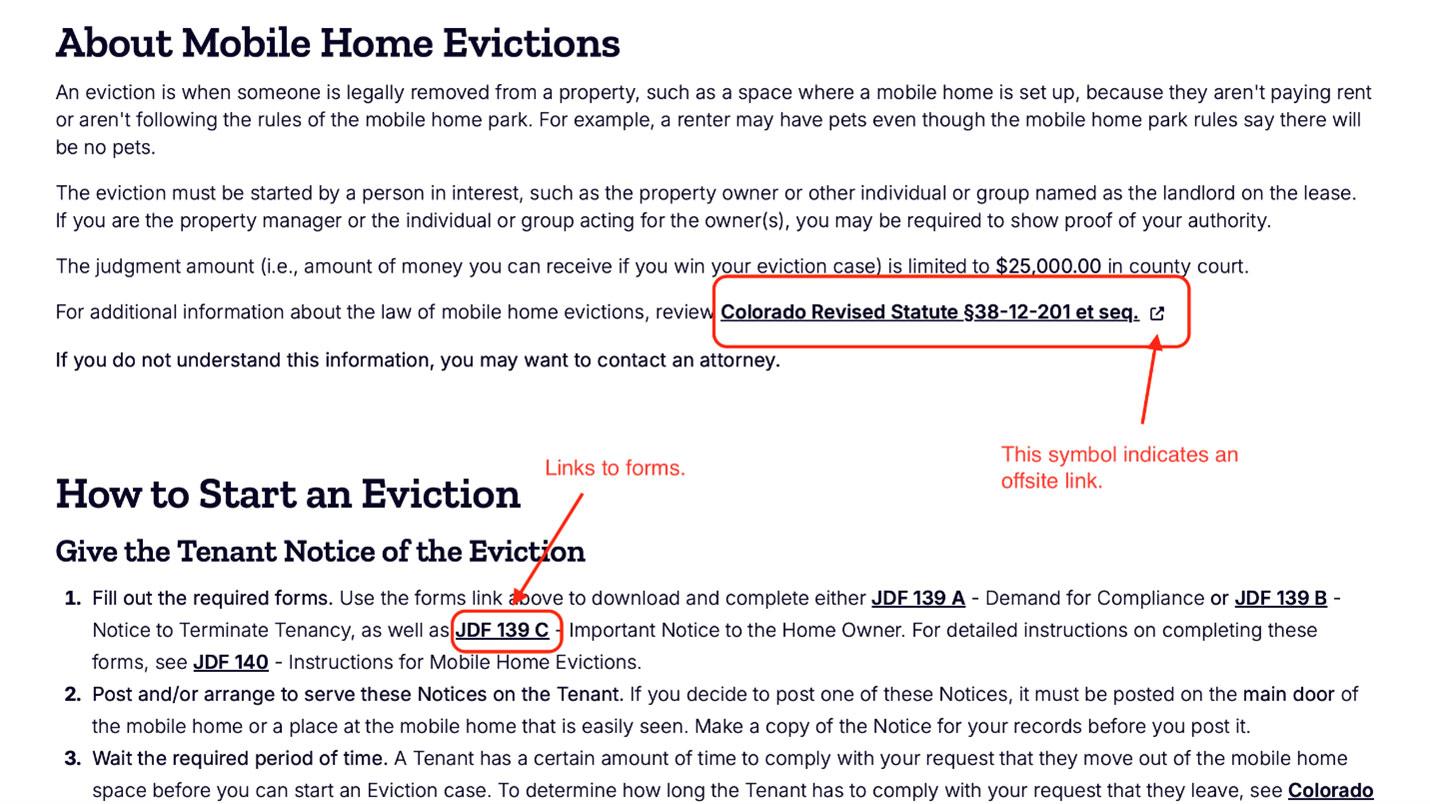
At most, a given page will include an overview of the relevant topic or procedure, a how-to guide or FAQ, the required forms, and additional helpful links. At minimum, it will provide the necessary forms, though many pages contain some combination of explanatory content and practical resources. With this understanding, a law librarian approaches the site as a curated repository—another reliable, free resource for state law to consult when needed.
Primary Sources: The Court Sites as More Than Logistical
Practitioners, laypersons, and other visitors to coloradojudicial.gov are unlikely to question whether they are the intended audience for the first menu heading, “Courts.” One would expect that heading to lead to contact information, directions, and other logistical details. Indeed, the submenus guide users to pages where they can locate trial courts by county or judicial district, as well as to dedicated sections for the court of appeals, supreme court, and water courts, where such institutional information resides.
Some users may be surprised to find the “Livestreaming” and “Community and Educational Resources” submenus also residing under “Courts.” However, this placement reflects the plain-language mandate governing Colorado’s government websites: A user would look under “Courts” if they need to livestream proceedings or find educational resources about the judicial system.
FIGURE 4. “Courts” dropdown menu at https://www.coloradojudicial.gov.

A law librarian sees the “Courts” menu as a gateway to primary authority. Selecting the “Supreme Court” submenu leads to the highest state court’s landing page, where a prominent “Special Announcements” heading highlights a searchable database of supreme court opinions.
FIGURE 5. Supreme Court page at https://www.coloradojudicial.gov/supreme-court.

Selecting that link leads to the “Colorado Case Law Search” page, where users can locate both supreme court and court of appeals opinions. At first glance, it may seem like this is a whole different website, as it lacks the main navigation menu from the Judicial Branch’s home page. But the upper-left corner displays the same Colorado Judicial Branch seal and typography, along with a link back to the main site. These visual cues signal that the database remains an official judiciary resource, and a quick review of the address bar confirms the coloradojudicial.gov domain.
FIGURE 6. Colorado Case Law Search page at https://research.coloradojudicial.gov.
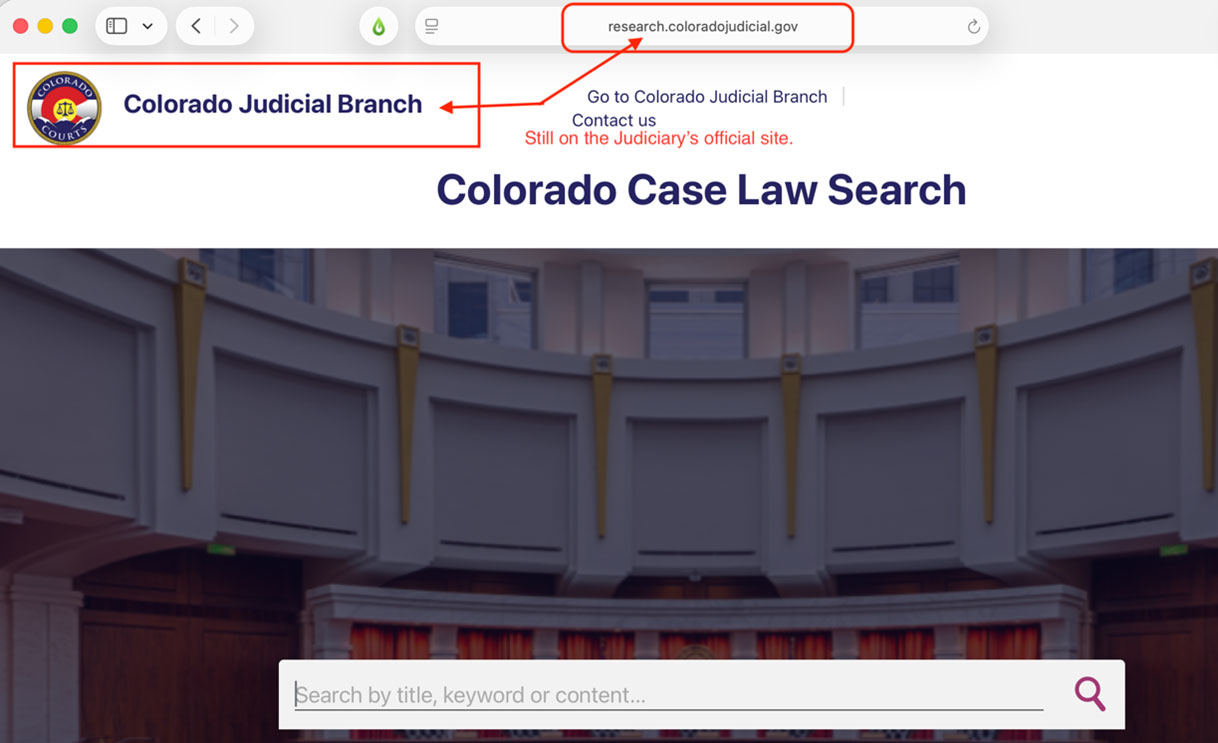
The “Colorado Case Law Search” page has a prominently displayed search bar, with links to separately organized supreme court and court of appeals opinions immediately below. On the right side of the page, a menu provides additional links to the Colorado General Assembly, the Colorado Revised Statutes and Court Rules, and the Code of Colorado Regulations. Both law librarians and practitioners should feel at home here.
The general search returns results from both appellate courts and allows users to narrow results by court, publication status, and date. Notably, however, the site does not offer an advanced search feature.
Once an opinion is selected, the database provides several useful tools: a complete citation, a “search within” function, a table of contents, links to other opinions within the database, options to download or share the opinion, and highlighted search terms. Although the database does not hyperlink cited Colorado or federal statutes, regulations, or cases, references to other Colorado and federal court opinions are rendered in blue text, making them easier to spot.
FIGURE 7. Sample Court of Appeals opinion at https://research.coloradojudicial.gov/en/vid/892939412.

Judicial opinions are not the only resources the Judicial Department’s court pages offer to legal researchers. Chief Justice Directives, for example, are an often-overlooked source of administrative authority governing aspects of statewide practice. Under the “Supreme Court Resources” heading, users will find a link to a searchable index of Chief Justice Directives dating back to the 1980s.
FIGURE 8. Link to Chief Justice Directives at https://www.coloradojudicial.gov/supreme-court.

This link leads to an index of all Chief Justice Directives currently in effect. Users can search this index by topic or number, or browse the list of directives.
FIGURE 9. Chief Justice Directives page at https://www.coloradojudicial.gov/supreme-court/chief-justice-directives?topic=78&wrapped=true.

If a law librarian received a research question about how to handle abandoned estate documents, for example, this is where they would look first.
FIGURE 10. List of Chief Justice Directives at https://www.coloradojudicial.gov/supreme-court/chief-justice-directives?topic=78&wrapped=true.

Likewise, practitioners can find important answers to questions that are not routinely answered in the Colorado Rules of Civil Procedure. Though the older, repealed documents are only referenced, the citation allows a practitioner to easily request the document from the State Court Administrator’s Office.
Public Access: Don’t Miss Out on Data and Reports
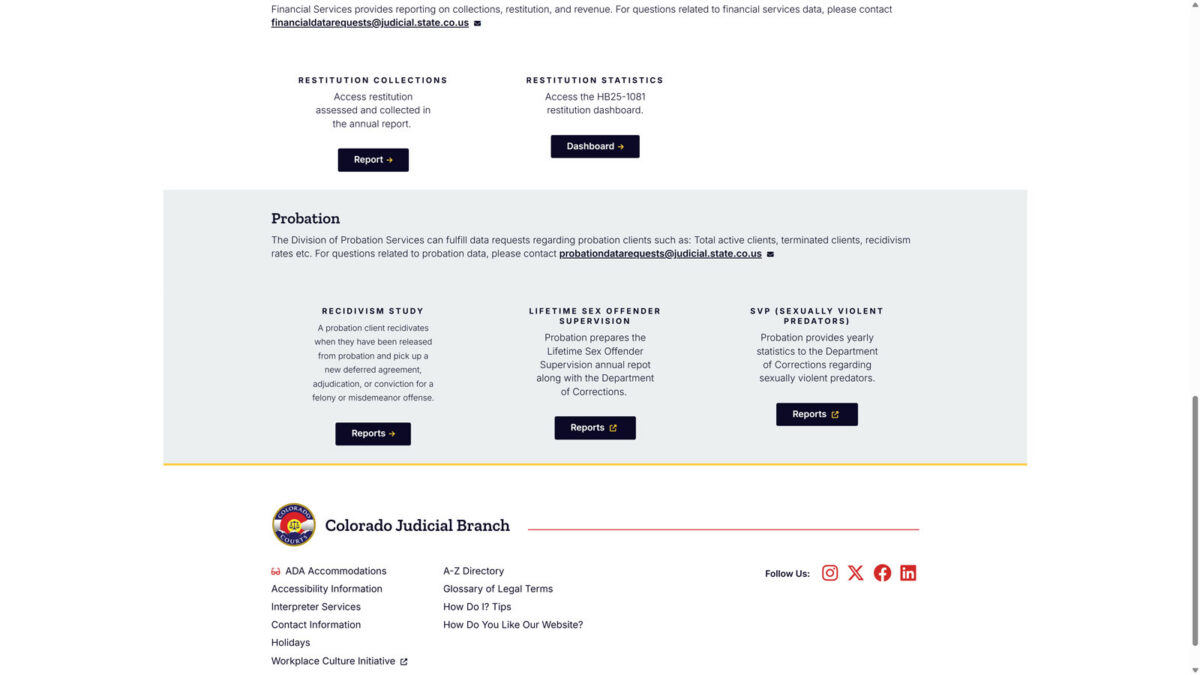
The “Data and Reports” submenu under “Public Access” contains a wealth of empirical and contextual material that practitioners may overlook. Here, practitioners can access annual probation statistics, court evaluations, eviction statistics, and other data-rich resources.
Law librarians regularly draw on these materials to provide broader context for research and reference work. The reports frequently include statewide trends, outcome metrics, and programmatic analyses that are not as readily available in commercial legal databases. For instance, the Probation Department’s Lifetime Sex Offender Supervision Annual Report includes detailed information on staffing levels, mental health service providers, and recidivism rates—data that may strengthen arguments for alternative sentencing or shed light on systemic constraints within the judicial system.
FIGURE 11. Data and Reports at https://www.coloradojudicial.gov/data-and-reports.
More broadly, these materials illustrate how judicial policies and initiatives function in practice. When empirical support is useful—or required—they can meaningfully enhance legal analysis and advocacy.
Evaluating Reliability and Currency
Even when using an official court website, law librarians evaluate materials for coverage, currency, and reliability.6 This approach helps prevent researchers—practitioners included—from relying on superseded authority, outdated forms, or obsolete procedures. The site’s structured menu and the presence of the judicial seal provide visual continuity, signaling that the user remains within the official judiciary domain while navigating between pages. As a result, materials located within this environment are generally more reliable than an unattributed PDF surfaced through a general search engine.
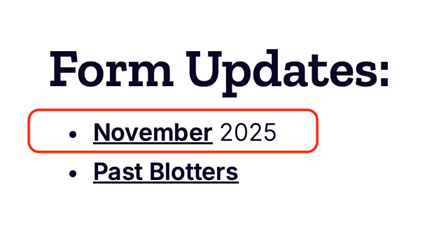
Still, it’s important to check materials for currency. The Forms page includes a “Form Blotter” that lists recent updates and links to revised judicial forms. If a practitioner is working from a form they downloaded a year ago, the format may not have changed, but the authority might have. Librarians also cross-check authority.
FIGURE 12. Form Updates at https://www.coloradojudicial.gov/self-help-forms.
If a statute is referenced in a self-help guide, a relevant form, and a recent opinion, it is current. Likewise, if a news release mentions a Chief Justice Directive and it also appears in the Chief Justice Directives index with a recent date, that consistency reinforces its currency and authority. Practitioners can incorporate the same habit, which is quick and easy with a site this easy to navigate.
Conclusion
The Colorado Judiciary’s website is designed to be navigable by all users. It is precisely this accessibility that makes it such a powerful research tool. When approached with a law librarian’s eye, the site reveals a wealth of legal research resources hidden in plain sight. A simple shift in perspective—from viewing the site solely as a platform for procedural tasks to recognizing it as a curated repository of authority—is all it takes for a practitioner to access this research goldmine.
Explore This Issue

Finality and Timeliness in Civil Appeals
Appellate Law
By Paige Mackey Murray and Sharlene J. Aitken

The Evolution of Colorado’s Anti-SLAPP Statute
The Civil Litigator
By Michael Beylkin and Steven Zansberg
Related Topics
Notes
1. HB 21-1110 (2021).
2. “Introduction to Understanding WCAG 2.1,” https://www.w3.org/WAI/WCAG21/Understanding/intro#understanding-the-four-principles-of-accessibility.
3. Colorado Governor’s Office of Information Technology, “Plain Language: Impact,” https://oit.colorado.gov/standards-policies-guides/guide-to-accessible-web-services/plain-language?utm_source=chatgpt.com.
4. Colorado Legal Resources, “Welcome to the Colorado Legal Resources Public Access Web Site,” https://advance.lexis.com/container?config=0345494EJAA5ZjE0MDIyYy1kNzZkLTRkNzktYTkxMS04YmJhNjBlNWUwYzYKAFBvZENhdGFsb2e4CaPI4cak6laXLCWyLBO9&crid=4d224a28-b6b6-409d-848f-5b9967b0b367.
5. For example, the Demand for Compliance Form notes which CRS section provides that a tenant may have a right to mandatory mediation at no cost to them before a landlord starts eviction proceedings. JDF 139 A, https://www.coloradojudicial.gov/sites/default/files/2025-03/JDF139A.pdf.
6. American Association of Law Librarians, Guide to Evaluating Legal Information Online, https://www.aallnet.org/advocacy/government-relations/recommended-guidelines/access-to-legal-information.