
Melissa C. Meirink
August 2026
Download This Article (.pdf)
The Colorado Bar Association and the Colorado Judicial Institute’s Diversity on the Bench Coalition are proud to present this series highlighting judges who serve communities across Colorado. Through these profiles, readers can learn more about the people behind the bench—their backgrounds, career paths, and the experiences that shaped their judicial service.
This month, the coalition is pleased to feature Judge Melissa C. Meirink of the Colorado Court of Appeals. We are grateful to Judge Meirink for sharing her story and hope it inspires students, future lawyers, and others interested in public service. If you enjoyed this profile, we encourage you to share it with colleagues, students, and members of your community.
If you’re interested in meeting or speaking with Judge Meirink, please contact coalition co-chairs Judge Cynthia D. Mares (ret.) or Judge Mariana Vielma at diversity@cobar.org.
Roots and Beginnings
Judge Meirink’s story begins with a multicultural upbringing that helped shape her perspective both personally and professionally. She was born in Mexico and moved to the United States when she was about 2 years old. Her parents had met in Mexico—her mother is Sonoran Yaqui, and her father is white with Russian ancestry.
Her family lived in Ohio until she was 4, when they moved to Colorado. She grew up in Westminster and attended a Catholic grade school where she and her brother were one of a few Latino students. Being one of the only students from a different cultural background was not always easy. She recalls being teased for being different—experiences that made her feel self-conscious about her heritage at a young age. For a time, she even felt embarrassed about her culture and avoided speaking Spanish in public.
That perspective began to change when she reached high school, where her culture was celebrated rather than criticized, helping her grow more confident in her identity. She later attended the University of Colorado and Seattle University School of Law, which she credits as an incredibly supportive environment. She often reflects on how much she benefited from the support of her law school, its professors, and her classmates. While there, she built strong friendships with members of the university’s Native community and several surrounding tribes. Seattle University School of Law is also known for having one of the strongest legal writing programs in the country, and the rigorous training she received there enabled her to develop skills that later helped her stand out as a job applicant. Looking back, she recognizes that her early experiences and education played an important role in shaping the perspective she brings to her work today.
Motivation to Attend Law School
When she was young, Judge Meirink believed she would become an orthopedic surgeon. However, once she began college, she quickly realized that chemistry and other science classes were not her strengths. As a result, she changed her major from biology to English and history, focusing her studies on the American Southwest and the emergence of modern Mexico.
At the time, she was unsure what career path she could pursue with those degrees. That changed when a friend invited her to attend a pre-law club meeting. There, she discovered the possibility of practicing federal Indian law to help protect cultural resources and sacred tribal sites. The idea immediately resonated with her, combining her interests in history and archaeology with the law, and it ultimately inspired her to pursue a legal career.
Overcoming Barriers
Judge Meirink describes her freshman year of college as “disastrous.” Because she was still pursuing a biology major at the time, she took mostly science and math courses and struggled academically. Although her grades improved significantly after she changed majors, her early grades continued to affect her overall GPA. In addition, she did not score as well as she had hoped on the LSAT, which made her worry that she might not be accepted into law school.
Even if she was accepted, financing law school presented another major concern. Fortunately, she was accepted into law school, and her law school awarded her several scholarships, which significantly reduced the amount she needed to borrow in student loans.
Building Expertise
After graduating from law school, Judge Meirink joined Holland & Hart’s natural resources practice group, where she focused on federal Indian law, historic preservation, and environmental law. She spent six years there before making a lateral move to Greenberg Traurig, where she continued practicing in the same areas. Her work involved ensuring that clients complied with environmental regulatory laws. This often required extensive travel, meetings with federal and state agencies, and litigation at both the trial and appellate levels. Her experience in private practice prepared her well for the bench because she understands firsthand what it is like to work in the “trenches” drafting motions, pleadings, and briefs.
Judge Meirink’s practice was also unique because many of her cases began at the administrative level and continued through trial and appellate courts. As a result, she developed administrative, trial, and appellate experience—something she notes is relatively rare. Today, that background helps her anticipate what attorneys and parties expect from the court and allows her to be mindful of those expectations when making decisions.
Over time, however, she realized that the demanding schedule and constant travel made it difficult to be the mother and wife she wanted to be. Despite being on track to become a partner at her firm, she made the difficult decision to step away from private practice. She took a year off to rest, reflect, and reassess her goals. When a staff attorney position opened at the Colorado Supreme Court, she applied and was hired. She spent the next 10 years in that role, describing the experience as incredibly rewarding. While she loved her work there, she eventually realized that becoming a judge would allow her to make an even greater impact.
Community Involvement and Leadership
Judge Meirink has long been—and still is—deeply committed to community service and improving access to the legal system. She is a member of the state’s Access to Justice Commission and serves as co-chair of the Colorado Hispanic Bar Association’s Access to Justice Task Force. Her involvement reflects her belief that everyone should be able to access and understand the legal system. Much of her work focuses on making courts more accessible by promoting the use of plain English in court rules and forms, expanding translation services, and ensuring that important legal forms are available in Spanish and other languages.
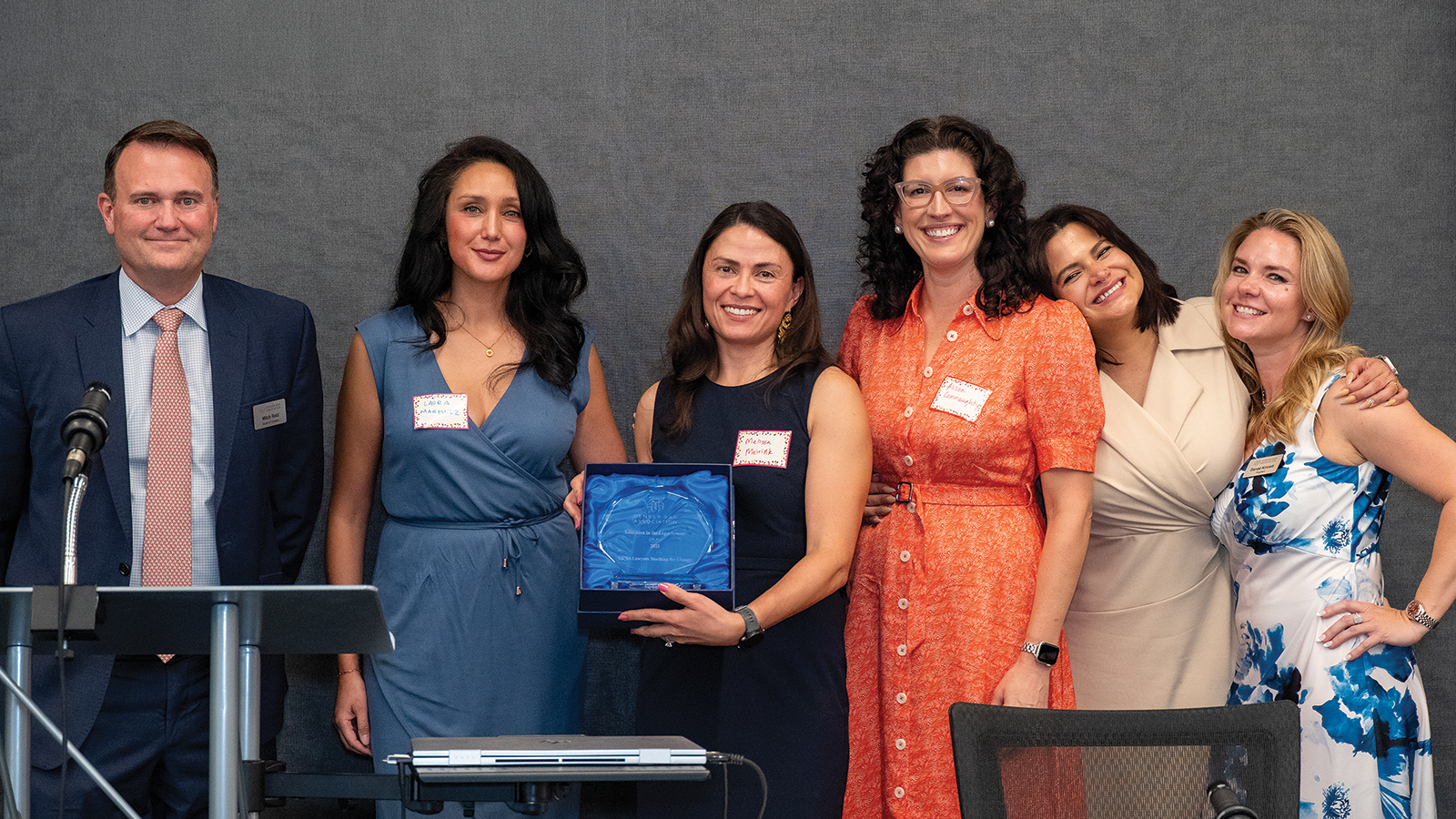
In addition, she serves as chair of the Colorado Women’s Bar Association’s Lawyers Teaching for Change program. Through this initiative, volunteer lawyers and judges visit elementary schools across Colorado to talk to students about careers in law and to guide them through mock trial exercises. The program is especially meaningful to her because many students, particularly those in lower-income communities, may have never considered the possibility of pursuing a legal career. Through this work, she hopes to plant seeds of curiosity and possibility for the next generation. She is also proud that the program’s materials are available in Spanish, allowing volunteers to visit and engage with Spanish-speaking classrooms as well.
Striving for Diversity
For Judge Meirink, diversity on the bench is not just about representation—it is about understanding the communities the courts serve. She believes that diverse judges bring lived experiences that others may not have, allowing them to better understand the perspectives and challenges of the people who come before the court. “It’s not enough to simply be qualified,” Judge Meirink explains. “Judges must care deeply about the well-being of the communities they serve.” One of the best ways to do that, she notes, is to be part of those communities and to understand their concerns in a meaningful way. Judge Meirink encourages attorneys who are active in their communities and committed to meaningful service to consider pursuing a judgeship. Their experiences, she says, can help create a judiciary that is more compassionate, inclusive, and connected to the public.
She also believes that diversity strengthens the decision-making process itself. Judge Meirink recalls an experience early in her time on the court when she considered including a map in a written opinion to illustrate the boundary line in a property dispute. A colleague pointed out that a map could create accessibility challenges for individuals with visual impairments because audio readers might not interpret it properly. Together, they worked to ensure the information could be communicated in a way that would be accessible to audio readers. For Judge Meirink, this moment demonstrated how diverse perspectives help courts identify potential issues and create solutions that make the justice system more accessible for everyone.
Encouraging Future Leaders
Judge Meirink acknowledges that the process of becoming a judge can be challenging and sometimes discouraging. Applicants may apply multiple times before receiving an appointment, but she encourages those who are interested in judicial service not to give up. “Applying for a judgeship is probably not the most difficult challenge you’ve faced,” she says. “You’ve likely already overcome harder obstacles in your career or in life.”
She also believes that the legal community must continue working to recognize and eliminate bias while remaining open to the concerns of the public. Listening to communities without assuming what they need is essential for building trust in the judicial system.
Rewards and Challenges
One of the most humbling moments in Judge Meirink’s career came during the appointment process. She was deeply moved by the support she received from the legal community. Affinity bar associations, colleagues, friends, and members of the community came together to advocate for her appointment by submitting comments and contacting the nominating commission and the governor. Seeing how many people were willing to support her journey to the bench was a powerful and emotional experience.
Today, some of Judge Meirink’s most rewarding moments involve working with students and future members of the legal profession. She enjoys giving courthouse tours, speaking with students, mentoring interns, and guiding her law clerks. Her investiture ceremony also remains one of the most meaningful milestones of her career. Surrounded by family, friends, and colleagues, she remembers the overwhelming sense of love and support in the room.
Another memorable moment occurred when she visited a Spanish-speaking classroom through the Lawyers Teaching for Change program. After introducing herself as a judge, one student stood up, smiled, and gave her a hug. The young girl explained that she wanted to become a judge someday but wasn’t sure if it was possible because she did not speak English very well. For Judge Meirink, the moment reinforced the importance of representation and showing young people that their goals are within reach.
Making a Difference
Judge Meirink’s path to the bench was not a traditional one. In fact, she often says that if someone had told her 10 years earlier that she would become a judge, she would have laughed.
She shares her story with others to remind them that career paths are rarely linear. What feels right during law school or early in a career may change over time, and that is perfectly normal. “Life evolves,” she says. “It’s okay to reassess, pivot, and choose a path that aligns with what matters most at that moment.”
Throughout her career, Judge Meirink has remained focused on making the legal system more accessible and inclusive. Whether through her service on the court of appeals, her work on the Access to Justice Commission, her efforts to expand language accessibility in court forms, or her outreach to students through the Lawyers Teaching for Change program, she continues to look for ways to strengthen the connection between the courts and the communities they serve. Her journey also reflects the importance of representation within the judiciary. By sharing her experiences and engaging with students, particularly those from underrepresented communities, she hopes to inspire the next generation to see that a career in law, or even on the bench, is possible. For her, the meaningful impact of her work is reflected not only in the decisions she writes, but also in the opportunities she creates for others to imagine themselves in the legal profession.
Explore This Issue

The Plain and Ordinary Meaning of Insurance Contracts in a Large Language Model World
Tort and Insurance Law
By Ronald M. Sandgrund