


“So Drastic an Action”
An Arrest for Perjury and a New Trial
September/October 2026
Download This Article (.pdf)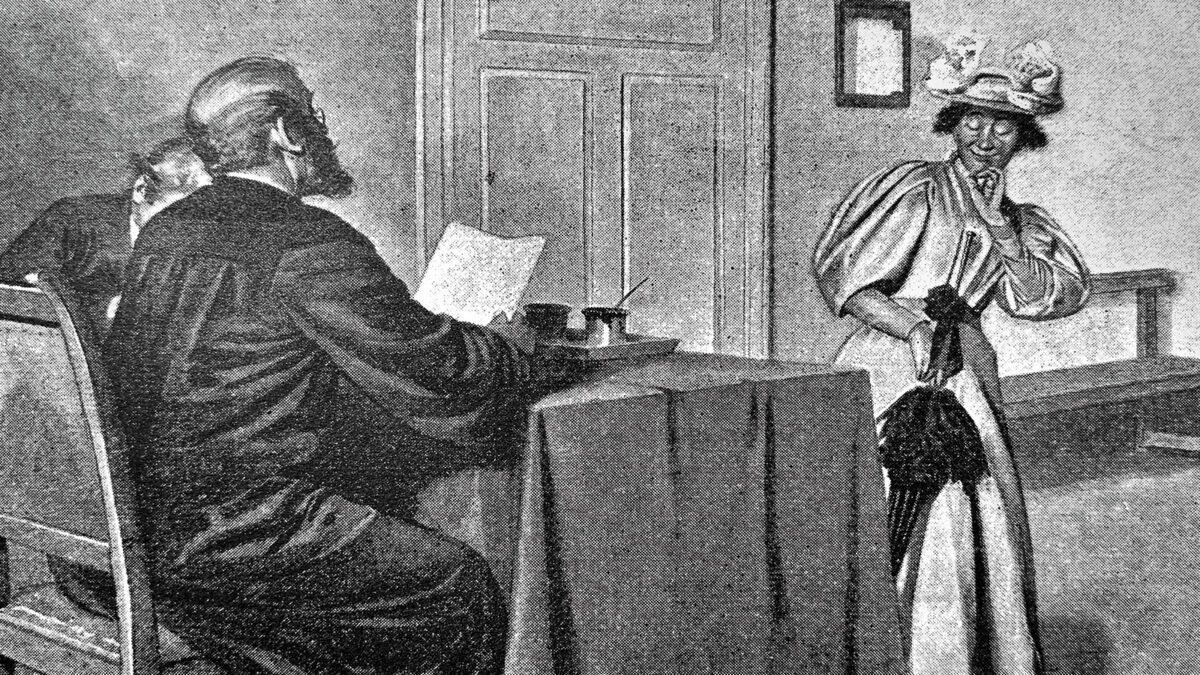
Witnesses at trial swear to tell the truth. Sometimes it appears they have not. Judges have authority to control the proceedings in their courtrooms, but should a judge act during trial against a lying witness? That problem arose in a 1909 Denver tort trial, leading to an interesting result on appeal.
The Injury
The afternoon of April 4, 1908, started out normally enough for Annie Sullivan, a 56-year-old woman who ran a Denver rooming house.1 After she finished her lunch at her home at 1713 Larimer Street, her friend Mr. Shryver dropped by her house to accompany her on a Saturday afternoon shopping trip. The pair made their way down to 15th Street, where they shopped for carpets at secondhand stores. Sullivan didn’t find the carpet she wanted, but she bought a couple of small mats at an auction.
Afterward, around 2:00 p.m., Sullivan and Shryver made their way northward through downtown. It was a windy day. They walked westward down 18th Street, home to several hotels and future home of the Denver Post Office. They passed 18th and California Streets and were walking toward Stout Street when Sullivan tripped over a mat lying on the sidewalk.
The woven wire mat Sullivan tripped on was half an inch thick and rectangular. It was lying in front of the Lewiston Hotel at 721 18th Street. According to Sullivan, the mat was bent at the corner so that it was “turned up” two inches.2
Sullivan’s fall to the sidewalk caused her serious injuries. Her treating physician, Herman Harry Martin, later testified that the fall severely strained her right shoulder and bruised her right side and leg. It injured her ligaments, causing her pain and physical limitations. Dr. Martin viewed her recovery as “problematical” due to her “advanced age.”3
The Plaintiff’s Case
Sullivan’s complaint, filed in Denver District Court, recited that due to her injuries from the fall, she could no longer work as the proprietress of a rooming house or at any other job.4 The complaint named as defendants the City and County of Denver and the Lewiston Hotel’s operators, Rosalin M. Hill and L.S. Hill. Sullivan sought $5,000 in damages. The City and County were later dismissed, and the case proceeded to trial against the Hills on June 10, 1909.
At trial, the presiding judge was Hubert Lincoln Shattuck.5 Judge Shattuck grew up in Greeley and graduated from the University of Denver College of Law in 1893. He was a Republican politician, a Mason, and a prominent member of the University Park Methodist Episcopal Church, where he taught Sunday school. In 1906, he was elected to the district court bench and began serving a six-year term. As a judge, he became known as a moralist who was not afraid of lecturing litigants or using his contempt powers to control recalcitrant witnesses. At one point, Judge Shattuck instituted a practice of giving every criminal defendant he sentenced a Bible and instructing them to read it.6
Sullivan’s Witnesses
Sullivan’s case-in-chief featured testimony from her physician Dr. Martin and herself.7 She also called Frank McGee as a witness. McGee had been overseeing the Lewiston Hotel on April 4, the day the accident occurred. He testified that the hotel staff put the wire mat outside for people to step on when bringing luggage in or out of the hotel. When not in use, the mat was supposed to stay inside the hotel. McGee also testified he saw someone fall on April 4, characterizing it as “a partial fall, not a flat fall.”8 But he claimed he couldn’t be sure if the person who fell was Sullivan. He explained that whoever fell that day had been dressed differently than Sullivan now appeared in the courtroom.9
The Defense Case
The defendants’ case started out ordinarily enough. Their first witness was Dr. A.L. Bondy, an osteopath. He testified that he had seen Sullivan in May 1908 after her fall. He examined her right arm and shoulder and found no discoloration or bruising. Nor could he detect any fracture or injured ligaments. After seeing her, he turned her over to a different physician. Dr. Bondy stated he did not understand her “case,” presumably meaning the source of her alleged pain and disability, but in his opinion a cold or chronic rheumatism could cause pain like hers.10
The defense then recalled Frank McGee to the stand. Contrary to his previous testimony, he now stated he recognized Sullivan in the courtroom. Now that she had testified, he claimed he recognized her voice.
McGee then described what he claimed to recall of the events of April 4. His testimony differed from Sullivan’s, to put it mildly. He said when he saw her, she was walking alone to the east, toward California Street.11 He thought she seemed a little dizzy. At one point, she put her hand against the building to steady herself. She then walked on, struck her foot against the mat, and “came down upon one hand, and then put the other hand down and got up.”12 When she got up “she did not walk right straight.”13 He heard her say, “I came pretty near to tumbling, didn’t I?”14 But he did not speak to her in reply. She continued walking, and when she got to the corner, he noticed her talking to a man there.
The defense next called Henry A. Myers, a traveling salesman for Scott Supply and Tool Co. who was staying at the Lewiston Hotel on April 4. He testified that on the morning of April 4, he met McGee as he was leaving the hotel. The two men saw a woman walking toward Stout Street, and Myers heard the woman speak to McGee. He testified that the woman appeared to be under the influence of alcohol, even though it was only 9:30 in the morning.
Myers said he couldn’t be certain the woman he saw that morning was Sullivan. But the woman he saw was swaying side to side and looked drunk. McGee remarked to him that the woman was “full as a goat.”15
Dr. Martin was recalled as a witness. He stated he had treated Sullivan for 10 to 12 years and had never noticed her to be under the influence of alcohol or noticed the odor of alcohol on her breath. He had always known her to be sober. And she had no nervous disease that would cause her to be dizzy.
At this point, Judge Shattuck did something unexpected. He excused the jury and called McGee and Myers to the bench, where he accused both witnesses of deliberate and willful perjury based on their testimony. He ordered them to be arrested and held on $1,000 bond. Deputy sheriffs removed the men from the courtroom, and the trial was adjourned until the next day.
The following day, the defense called additional witnesses, including a special officer of the City Attorney’s Office who testified about the sidewalk and the size of the mat. Defendant Rosalin Hill also briefly testified about the hotel’s procedures involving the mat. The defense then recalled Sullivan, who insisted “she was not dizzy when she was walking on 18th St., that she did not drink beer except in her own home, would not drink five glasses in a year [and] was not dizzy when she fell.”16 Sullivan also returned as a rebuttal witness, again insisting that she had been neither dizzy nor under the influence when she fell and in fact had never been intoxicated in her life. She also denied having ever seen or spoken to Myers or McGee before she came to court. With that, the parties rested.
The jury returned with a verdict in favor of Sullivan for $600. After the verdict, the trial court strenuously examined the jurors to determine whether any of them were aware that two of the defense witnesses had been arrested for perjury, and whether such knowledge could have had anything to do with their verdict. The jurors denied having been unduly influenced in their verdict. Judge Shattuck denied a new trial,17 and the defendants appealed.
The Appeal
The court of appeals noted that each member of the court had given the appellate record “much more than the ordinary consideration, because of our unwillingness to disturb the judgments of trial courts.”18 The court felt the evidence for the plaintiff’s case was weak, and the judges were divided about whether she could have made her case under the doctrine of res ipsa loquitur. But they did not find it necessary to resolve that question, because Judge Shattuck’s response to the alleged perjured testimony required reversal of the judgment and remand.
After describing the trial judge’s action against McGee and Myers, the court opined that it had been “unable to discover anything in the testimony of the two witnesses that would warrant so drastic an action on the part of the trial judge.”19 His actions in “severe arraignment of the witnesses, and his placing them under arrest or bond,” would not only tend to intimidate other defense witnesses, but could also have prevented the two men from offering any further testimony favorable to the defense case.20 The court lectured Judge Shattuck on his duty to exercise “extreme caution and great self-restraint, to the end that [his judicial] power and influence be so exercised as to protect, rather than endanger, the right of litigants who appeal in [his] court[].”21 With perhaps some understatement, the court opined that
[w]here witnesses of one of the parties to a suit are promptly, upon leaving the stand, and in the midst of the trial, called by the trial judge to the bar of the court and publicly denounced as perjurers, and placed under arrest, it seems probable that the rights of such party would be thereby prejudiced.22
Given the rather weak evidence of negligence, the error was particularly prejudicial to the defendants and therefore required reversal. The case was remanded for a new trial.
Aftermath
It is unclear whether this case was retried. In his later years, Judge Shattuck served as a district attorney and in private practice. He died on August 5, 1939.23
In later years, the Lewiston Hotel became a home for transients. A 1974 fire that started in one of the rooms at the hotel killed three people and injured a dozen more, in part because the hotel’s antiquated architecture made it difficult for residents to escape. It was later discovered that fire doors had been propped open, and a man whose mattress caught on fire on the second floor delayed telling anyone until the fire had reached the hallway, then ran out of the hotel without warning his fellow residents.24 After the fire, the hotel stood vacant for several years, occupied by squatters. It was eventually torn down.
Explore This Issue

CBA’s 2026 Legislative Session in Review
Legislative Matters
By Tyler Mounsey

Colorado’s Adverse Possession Law
Real Estate Law
By Joshua D. McMahon
Notes
1. The facts are taken from the Colorado Court of Appeals decision in Hill v. Sullivan, 131 P. 1040 (Colo.App. 1913), and from the Abstract of Record filed in the Colorado Court of Appeals. The Abstract of Record (hereinafter referred to as “R.”) is available at the Colorado State Archives under Colorado Court of Appeals case number 3592.
2. R. at 17.
3. Id. at 14.
4. Id. at 4.
5. Judge Shattuck’s biographical details are from Stone, History of Colorado, (vol. II) at 252–54 (S. J. Clarke 1918).
6. “Judge Gives Bibles With Prison Sentence,” Glenwood Post p. 3, col. 2 (Apr. 27, 1912).
7. She stated she had attempted to find Shryver to call him as a witness, and had even attempted to subpoena him, but he could not be found. See R. at 17.
8. Id. at 12.
9. Sullivan also called defendant Rosalin Hill to testify that she had left McGee in charge of the Lewiston beginning March 9, 1908, and that he had been in charge on the day of the accident.
10. R. at 21–22.
11. To confuse things, on cross-examination he stated she had been walking toward Stout Street (i.e., to the west).
12. R. at 23.
13. Id.
14. Id.
15. Id. at 29. According to a slang dictionary, this phrase, which originated in the 1800s, refers to having eaten too much or being intoxicated. “Full Of,” https://greensdictofslang.com/entry/wtdg3di#jq53mgq.
16. r. at 33.
17. Judge Shattuck stated he had asked the newspapers not to publish anything about the arrest until the jurors had received the case. The arrest made the Rocky Mountain News on June 12, the day the jurors returned with their verdict. “Arrest Witnesses on an Order by Trial Judge,” Rocky Mountain News (Daily) p.3, col. 6 (June 12, 1909).
18. Hill, 131 P. at 1041.
19. Id.
20. Id.
21. R. at 1042.
22. Id.
23. “H. L. Shattuck Funeral Set for Tomorrow,” Rocky Mountain News p. 10, col. 1 (Aug. 6, 1939).
24. “Hotel Death Toll is Linked to Stall in Reporting Fire,” Rocky Mountain News p. 5, col. 4 (May 22, 1974).