


The Truth Is Out There
Mastering Public Records Research
May/June 2026
Download This Article (.pdf)
In many ways, a skilled researcher investigating public records is like a savvy detective running down leads and making connections across disparate data points. This is probably why many of the episode taglines from the hit 1990s TV show The X-Files—which follows the exploits of two FBI agents specializing in supernatural occurrences—seem so appropriate to a discussion of public records research. Anyone who has delved into this type of research can tell you that it can sometimes seem like the records you’re tracking down are as elusive as the extraterrestrial beings featured in that show.
Definition
What exactly do we mean by “public record”? Legally, public records are often thought of in relation to federal or state Freedom of Information Act (FOIA) requests, which grant the public the right to access certain government records. The federal FOIA statutes only apply to agency records, not records of the courts or legislature. Most states have their own versions of FOIA statutes. They vary from state to state but often include additional types of records. The Colorado statutory definition of “public records” is notably broader than its federal counterpart and includes records from any “political subdivision of the state” and nonprofit corporations.1 A researcher’s definition of “public record” is typically even broader and includes any record that provides us with information on an individual or business entity. This encompasses both information that is publicly accessible, like social media posts and news articles, and information accessible through a commercial database.
Strategy
Despite the wide variety of public records, there are three strategies borrowed from X-Files taglines that will apply no matter what type of information you’re looking for.
“The Truth Is Out There”
The truth is out there—the trick is knowing where to find it. When starting your research, it’s often helpful to ask yourself: Where might the person or entity you’re researching be required to disclose information? For example, if the entity you’re researching is involved in the insurance industry, it’s likely regulated in some way by the state in which it conducts business. An investigation of the state agency regulating insurance could yield information about licensure or regulatory actions involving an insurance agent or agency.2 At minimum, most people will have some basic vital records (birth, marriage, divorce, death),3 and most companies will be registered in the state in which they do business. It’s also helpful to ask yourself: Where might this person or entity voluntarily disclose information? Have they been in the news? Do they have a website? Have they posted information on a blog or social media site? These sources can provide valuable clues that will direct you toward the next logical steps in your research process.
“You See What I Want You to See”
You see what I want you to see—just because you aren’t finding a record that you think should have been disclosed doesn’t mean it doesn’t exist. Notably, even though Delaware corporations are required to file articles of incorporation with the state, they are not made readily available online.4 Sometimes the best course of action involves picking up the phone and contacting the agency, court, or locality to see if they can provide the information needed. Contacting a state or local library can be helpful too. State and local librarians are often subject matter experts in local records, and sometimes their libraries are repositories for certain record types. You also might consider placing a FOIA request. While federal requests are notorious for being lengthy and time-consuming processes, depending on the state and the agency, state FOIA requests are often informal processes with comparatively quick turnaround times.
“Trust No One”
Trust no one—or at least be careful what you trust. Evaluate the source of your information. Is the document directly from a governmental body, or is a third-party intermediary providing the information? Information from third parties, the news, social media, and subscription databases can be outdated or misstate key data points, making it especially important to verify the information with records from a governmental source. While it’s not always possible, it’s a good idea to verify information, even from official government records, using multiple sources.
Public Records Reports
Most attorneys working in larger law firms or government agencies will have the ability to run a public records report using a commercial database like Westlaw or Lexis. Public records reports are great because they search across multiple types of records and jurisdictions at once and help us to determine where additional records might be held. For instance, a public records report might reveal that a company registered in Delaware is also registered in Colorado. And, while you can’t readily obtain a company’s articles of incorporation from Delaware’s Secretary of State website, you should be able to get them from Colorado’s Secretary of State website.5
While these reports are huge time savers and great starting points, it’s still important to remember to “trust no one” and remain skeptical of the information in these reports. We can do this by (1) carefully evaluating the information in the report, (2) verifying it with another source, and (3) checking the coverage of the database we’re using to generate the report.
Evaluate
The first step when working with any resource—especially a public records report—is to evaluate the information provided in the report. If a public records report includes 12 phone numbers, for example, you’ll want to determine which numbers are most likely to be correct so you don’t waste time calling the wrong numbers. Most public records reports will allow you to click through to view the full record stored in the underlying databases. The full record for a phone number will provide the source of the information, the dates, and associated address. These clues can help you determine which number or numbers are more likely to be associated with the person or entity you’re researching.
Verify
The next step is to verify the information. For example, if a report indicates that an individual owns real property, you should confirm that the details are still accurate by comparing them with the records on file in the jurisdiction in which the property is located. Property information is typically maintained by localities (cities or counties), and each locality may choose to handle their records differently.
Many public-facing websites will not let you search property information by name, so using a public records report to start locating properties is a great time saver. Nationwide Environmental Title Research (NETR) Online has a comprehensive listing of most available online sources for property records across the country (see Fig. 1).6

The NETR Online record for Denver County public records indicates which local agencies hold property records. The Denver Recorder will likely have the full text of recorded deeds and other land records and will typically be the best place to start. The Denver Treasurer and/or Denver Assessor will provide additional information about the property, including assessed property value.Typically, the clerk of court, register of deeds, or county recorder’s office is the custodian of recorded deeds and other land records and the best place to look for real property records, but a subscription is often required to view their documents. If online access to records held by the clerk of court is by subscription only, you may still be able to view their records in person. Best practice is to call the custodian of the records to determine whether there are options for accessing the records.
The next best options for accessing property information are the city assessor or the city treasurer. City assessors or treasurers often provide rich information about a property. Their records could potentially include a list of deed transfers, information about the structure, tax assessment history, and more. In this case, the public records report enables you to find the official government records and, in verifying those records, you can find a wealth of additional information.
Check Coverage
Public records reports are by their nature limited to the universe of documents contained in the underlying database (typically Westlaw or Lexis). These databases are comprehensive, but they are not exhaustive. Depending on the type of information needed, the jurisdiction, and the date, there could be significant gaps in the information provided in your report. This means it is very important to check the coverage. If you know where there are gaps in the coverage, you can find other resources that include the missing information to supplement your report.
Another great X-Files tagline that can be applied to public records research is, “All lies lead to the truth.” Even when information in a report is outdated or misattributed to the subject of your research, it can still provide valuable clues that lead you to an answer. For example, if the addresses in a report are incorrect but the report includes a relatively recent marriage record, you might be able to use another source, like social media, to determine whether the person in question has moved in with their new spouse.
If you don’t have access to public records reports via Westlaw, Lexis, or another commercial database, several online services allow you to purchase basic public records reports on an ad hoc basis. Alternatively, you can start with a web and news search to help identify other potential sources. From there, create a research plan that outlines the types of records that may be available for your subject and most useful to your project. Types of records to consider include:
- vital records
- addresses
- property records
- aircraft or vehicle records
- professional licenses
- military records
- voter registrations and campaign contributions
- corporate registrations
- SEC filings (for public companies)
- government contracts
- litigation records
- judgments
- liens
- UCC filings
Social Media Research—“They’re Watching!”
In its infancy, social media posts were a potential treasure trove of information. People posted about their seemingly inconsequential daily lives without any thought as to how valuable that information could potentially be. More recently, people have become increasingly aware of the privacy risks of social media and have adjusted their privacy setting accordingly. Social media platforms have also made it more difficult to access content without an account.
When conducting social media research, always consider the potential implications of your search and the privacy settings of the platform. If you’re doing juror research, some courts may consider social media research to be prohibited juror contact before trial.7 Some sites, notably LinkedIn, will alert users that you have been viewing their profile. Even if you have private browsing turned on, the person you view can still see that someone from your organization viewed their profile (see Fig. 2).
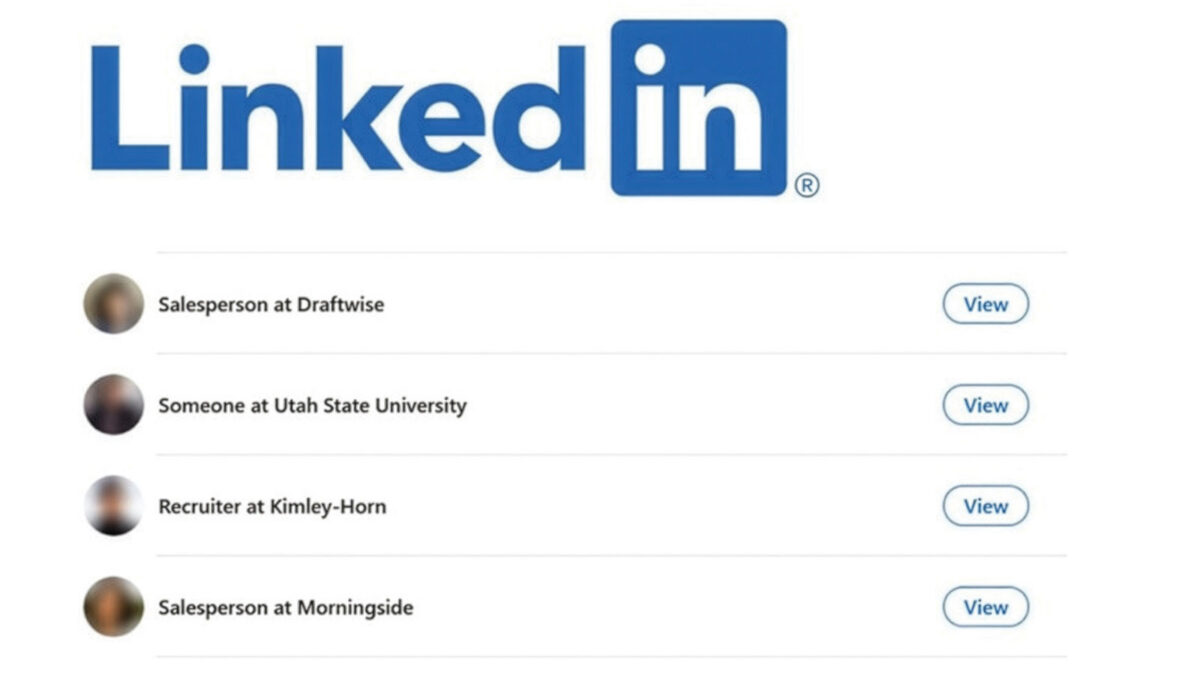
This can be a major source of concern if you don’t want that person to know that your institution is interested in them. Before using a social media site for research, carefully evaluate if it is appropriate for that request. If you are helping someone locate general counsel for a business development project, privacy is not as important as if you are investigating someone adverse to your institution.
Conclusion
While we may never prove or disprove the existence of extraterrestrial life, with good research skills and some persistence, we can uncover a wealth of information on the people and companies on this planet. The strategies outlined in this article—knowing where to find the truth, seeing beyond the surface, and trusting no one—are essential tools in the researcher’s toolkit. As we navigate the ever-evolving landscape of public records, it’s crucial to remain vigilant, skeptical, and resourceful. With these skills, we can ensure that no piece of information remains hidden, and that the truth, no matter how elusive, is always within our grasp.
Explore This Issue

The Total Price Requirement of CRS § 6-1-737
Professional Conduct and Legal Ethics
By Nicole Marie Black and Madison Rheinheimer

The 2026 AI-Related Amendments to the Colorado Rules of Professional Conduct
Professional Conduct and Legal Ethics
By Julia K. Martinez, Maria E. Berkenkotter, and Lino S. Lipinsky de Orlov
Related Topics
Notes
1. CRS § 24-72-202(6)(a)(I) (“‘Public records’ means and includes all writings made, maintained, or kept by the state, any agency, institution, a nonprofit corporation incorporated pursuant to section 23-5-121(2), C.R.S., or political subdivision of the state, or that are described in section 29-1-902, C.R.S., and held by any local-government-financed entity for use in the exercise of functions required or authorized by law or administrative rule or involving the receipt or expenditure of public funds.”).
2. Colorado Department of Regulatory Agencies Division of Insurance, Consumer Protection, https://doi.colorado.gov/for-consumers/consumer-protection.
3. VitalRec.com, https://www.vitalrec.com, is a useful site that provides links to state and local agencies controlling vital records across the country.
4. Delaware corporate records can be requested online for a fee. See Delaware Division of Corporations, Document Filing and Certificate Request Information, https://corp.delaware.gov/document-upload-service-information.
5. Colorado Secretary of State, Business Database Search, https://www.coloradosos.gov/biz/BusinessEntityCriteriaExt.do.
6. NETR Online, Public Records Online Directory, https://publicrecords.netronline.com.
7. Weiss, “Why Federal Judge Fined Alston & Bird $10K for Conducting Jury Research on LinkedIn,” ABA J. (Oct. 30, 2025), https://www.abajournal.com/news/article/why-federal-judge-fined-alston-bird-10k-for-conducting-jury-research-on-linkedin.