


Avoiding Unintended Due-on-Sale Defaults in Colorado Real Estate Loans
November 2026
Download This Article (.pdf)
This article offers practical guidance on how to avoid triggering due-on-sale clauses in real estate loans.
A due-on-sale clause generally gives a lender the right to accelerate a loan if the borrower transfers the property, or an interest in the property, without the lender’s prior written consent. In loans involving property that is owned through an entity, which is the case in most commercial loans, the clause may also apply to the direct or indirect transfer of an ownership interest in the borrower or a change in control in the borrower’s ownership structure. Because due-on-sale clauses are specific to each transaction, the specific loan document language controls. Some clauses apply only to transfers of title; others apply to leases, other encumbrances, transfers of non-possessory interests in the property, changes in control of the borrower, indirect ownership transfers, and other transactions. For example, the granting of an easement to an adjacent owner or the transfer of title from an individual to a limited liability company may trigger a due-on-sale clause.
This article focuses primarily on borrower-side risk: identifying when a proposed transfer may require lender consent and when failure to obtain consent may result in acceleration of the loan, foreclosure, or guarantor-liability exposure. As a rule of thumb, if a borrower wants to make any change in who owns, controls, occupies, is granted a non-possessory interest in the property, or receives some other possessory benefit from the property, counsel should review the loan documents before proceeding.
Enforceability of Due-on-Sale Clauses in Colorado
Colorado courts have generally upheld due-on-sale clauses, subject to limits for unconscionable enforcement and subject to applicable federal law. Although Colorado courts have long recognized the enforceability of due-on-sale clauses in deeds of trust, the Garn-St Germain Depository Institutions Act of 1982 (Garn-St Germain Act)1 provides certain exceptions for transfers of residential property.2 As a result, a different analysis applies to commercial and residential transactions.
In Malouff v. Midland Federal Savings & Loan Ass’n,3 the Colorado Supreme Court held that a due-on-sale clause in a deed of trust was not an invalid restraint on alienation where the lender used the clause to protect legitimate interests, including evaluating the new owner and adjusting the interest rate in light of market conditions. In Income Realty & Mortgage, Inc. v. Columbia Savings & Loan Ass’n,4 the court went further and held that due-on-sale clauses are per se reasonable restraints on alienation, although a borrower may still challenge enforcement where the lender’s conduct is unconscionable. Colorado cases also confirm that installment land contracts5 can constitute a “sale or transfer”6 for due-on-sale purposes, and that acceptance of monthly payments after a transfer does not necessarily waive the lender’s right to accelerate where the default is the unauthorized transfer rather than nonpayment.7 Additionally, in Kemp v. Empire Savings, Building & Loan Ass’n,8 the Colorado Supreme Court held that a lender may require prior notice and approval of a transfer and that the lender’s acceleration of a loan was permissible where the borrower breached the agreement to seek prior approval.
A variety of actions by a borrower may trigger a default under the due-on-sale clause. A trigger of the due-on-sale clause, in most mortgages,9 gives the lender the option to accelerate the debt. An acceleration of the debt by a lender means the borrower must pay the outstanding loan balance within a certain number of days. If the accelerated debt is not paid, the lender may pursue its remedies set forth in the loan documents, generally including foreclosure or declaring an event of default. The lender’s remedies may be cumulative. A prohibited transfer may support acceleration, foreclosure, default interest, fees and costs, cash-management triggers, reserve requirements, loss of extension options, and recourse liability, depending on the loan documents.
Commercial Loans
Commercial loans generally require a document-specific analysis. Unlike many residential transfers protected by the Garn-St Germain Act, commercial real estate transfers are primarily governed by the loan documents. Counsel should assume that lender consent may be required for any direct or indirect transfer unless the proposed transaction falls squarely within a negotiated permitted transfer provision specifically set forth in the loan documents.
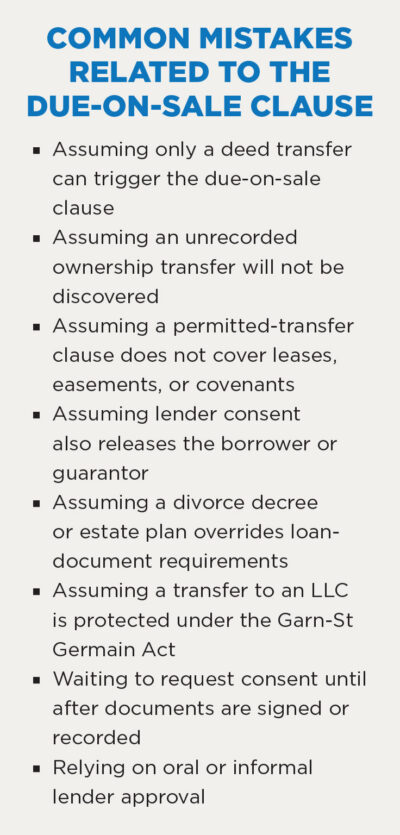
In commercial loan documents, counsel should distinguish among (1) transfers of title and transfers of other possessory interests in the property, including leases; (2) encumbrances of the property, including liens, easements, and covenants; (3) transfers of direct or indirect ownership interests in the borrower; and (4) changes in control, management, or key principals. A transaction may be permitted under one category but prohibited under another.
Below is an example of a due-on-sale clause in a typical commercial deed of trust (the capitalized terms are ones commonly defined in loan documents):
Except as expressly permitted in the Loan Agreement/Permitted Transfer provision, (a) upon the direct or indirect voluntary or involuntary sale, exchange, conveyance, encumbrance, transfer, alienation, removal or other disposition of (i) the Property, or any part thereof, or any interest therein, or (ii) all or part of the legal or beneficial ownership interest in Borrower,10 or (b) if the title to the Property or any part thereof shall become vested in any party other than Borrower in any manner whatsoever, the Note and obligations secured by this Deed of Trust, irrespective of the maturity dates expressed therein, at the option of Lender, and without demand or notice, shall immediately become due and payable, and Lender and/or Trustee shall be entitled to any remedies available to them under the Note, this Deed of Trust, or any of the other Loan Documents, at law or in equity.
The “permitted transfers” exception to the due-on-sale clause is often highly negotiated between the borrower and lender. If representing a borrower, the permitted transfers must be addressed at the term sheet, commitment letter, or other stage before the terms of the loan are finalized when the borrower still has leverage to negotiate the provision. A borrower will want to negotiate as a “permitted transfer” or otherwise an exception to the due-on-sale clause prohibition, at a minimum, transfers of the direct or indirect beneficial interests in borrower. For example, a borrower may negotiate permitted transfers:
(a) by and among those persons or entities that are members, shareholders or partners of Borrower as of the date hereof (Current Owners); (b) from the Current Owners to the members of the Current Owners immediate families, or trusts created for the benefit of said immediate family members, for the purpose of facilitating the bona fide estate planning of Current Owners and, (c) to a trustee of an estate upon the death of a Current Owner.
The lender’s limitations or conditions on such transfers may include advance notice; a narrative description and detailed pre- and post-transfer organizational charts of the borrower; confirmation that no default exists at the time of the proposed transfer; confirmation that the proposed transfer will not result in any violation of the covenants of the loan documents relating to any applicable laws; and, typically, continued control of both the borrower and the property by the key principals. The lender may determine and confirm that the proposed transfer will not result in a material adverse change.11 The borrower will likely be required to pay all of the lender’s expenses for reviewing and processing a proposed transfer. Before requesting a consent to a proposed transfer, it is critical to review both the loan document requirements for requesting such a consent and the borrower’s compliance with the loan documents.
Negotiating Permitted Transfers to Avoid Triggering the Due-on-Sale Clause
It is important to consider all potential triggers so that a borrower does not inadvertently or unintentionally trigger the due-on-sale clause through an unpermitted transfer. The above example of a permitted transfer carve-out does not include easements, leases, covenants, or other interests to the property; it is instead primarily focused on the indirect interests of the borrower. If representing a borrower, counsel may want to consider negotiating a more comprehensive list of permitted transfers that includes:
- transfers among existing owners;
- estate-planning transfers to family members and trusts;
- transfers upon death, disability, or incapacity of a principal;
- transfers to affiliates under common control;
- non-controlling transfers below a specified percentage threshold;
- transfers that do not result in a change of control;
- transfers required by divorce decree or settlement agreement;
- entity conversions, mergers, or reorganizations that do not change ultimate beneficial ownership;
- replacement guarantors following death or incapacity;
- leases entered into in the ordinary course of business;
- utility easements, covenants, and access easements; and
- partial transfers/releases, as applicable, if the loan covers multiple lots or parcels and the borrower intends to sell the individual lots or parcels.
Depending on the lender and the type of commercial loan, borrowers may or may not be able to negotiate all of the permitted transfers it desires, so prioritizing is key. It goes without saying that the definition of a “permitted transfer” must be consistent in all of the loan documents to avoid issues for the borrower and lender.
As a borrower, or as legal counsel to a borrower, it is important to consider what types of direct or indirect transfers of the property will need to be permitted during the term of the loan and specifically negotiated. For example, a borrower will not want to obtain the consent of the lender for every lease and will want to have a threshold of material leases that do not require lender consent. For leases, borrower’s counsel should consider whether the loan documents distinguish ordinary-course leases from material leases,12 ground leases, master leases, affiliate leases, leases with purchase options, leases exceeding a certain square footage threshold, leases below market rent, or amendments/terminations of major leases. If the property condition report (similar to an inspection report in a residential deal) identifies issues with the property that require substantial repairs, easements may be necessary for repairs, and consent for such future easements will need to be included in the loan documents. Due to the constantly changing nature of both wired and wireless communications, a borrower may also desire to have easements related to these services without having to obtain the lender’s consent. A borrower may want to be able to impose future covenants on the land, which will also require the prior written consent of the lender if not negotiated as a permitted transfer. It is also helpful to include language that consent will not be unreasonably withheld, conditioned, or delayed, as well as a process for how consent will be handled.
Other Issues Affecting Encumbered Property
Counsel should review the deed of trust, loan agreement, guaranty, and any intercreditor or cash management documents before advising on a variety of issues—whether during the term sheet negotiation, the loan document negotiation, or after the closing of the loan—including, but not limited to:
- transfers of membership interests, partnership interests, or shares in the borrower;
- upstream transfers in parent entities;
- death, incapacity, or estate planning transfers involving a principal or guarantor;
- transfers to revocable or irrevocable trusts;
- divorce-related transfers involving a principal or guarantor, particularly if there is a minimum ongoing guarantor net worth requirement;
- leases, especially long-term leases, ground leases, master leases, or leases with purchase rights;
- easements, declarations, covenants, reciprocal easement agreements, access agreements, or utility agreements;
- subordinate financing, mezzanine debt, preferred equity, pledges of ownership interests, or UCC collateral assignments;
- changes in control, manager, managing member, general partner, or key principal;
- conversions, mergers, domestications, or reorganizations of borrower entities;
- transfers to affiliates;
- tax-driven restructuring;
- admissions or withdrawals of members or partners; and
- transfers caused by foreclosure, receivership, bankruptcy, condemnation, or involuntary liens.
Bankruptcy, receivership, and foreclosure may impose additional limits on enforcement or timing, so counsel should analyze those issues separately if the borrower or property is distressed.
Guarantor Issues
A violation of the due-on-sale clause is problematic not only for the borrower, but also for the guarantor of the loan. A transfer that violates the loan documents may also trigger full or partial recourse under a non-recourse carve-out guaranty. Most commercial loans are non-recourse to the borrower, with certain recourse events triggering recourse liability to the guarantor. In most non-recourse carve-out guarantees, a guarantor has liability for any voluntary transfer of the property and for any direct or indirect transfer of a beneficial ownership interest in the property or borrower that is not defined as a permitted transfer. Because most commercial loans do not permit a transfer of the guaranteed obligations, a death of the guarantor is also usually included as a due-on-sale clause trigger in the guaranty or loan documents. It is critical to exclude the guarantor’s death from the recourse carve-outs and to permit the borrower to provide a substitute guarantor with a certain period of time of the guarantor’s death. Counsel should also confirm whether the guaranty treats unauthorized transfers, changes in control, subordinate financing, bankruptcy filings, or other transfers of ownership interests as potential triggers that may create personal liability for the guarantor.
Existing Debt
Even in commercial transactions, a borrower, or their counsel, may not realize that their potential actions could trigger the due-on-sale clause in their existing debt. Any transfer of the property, which includes any conveyance of a possessory or non-possessory interest, may trigger the due-on-sale clause. Before the loan closing, the borrower and lender agree in the loan documents on the “permitted exceptions” to title, and these generally include existing easements and covenants recorded in the real property records and existing tenancy agreements as of the date of the closing of the loan. If a client asks counsel to negotiate an easement, lease, covenant, or other document that may or may not be recorded that will transfer any interest in the property, counsel must review the recorded documents, including any mortgages, to determine if lender consent is required for the proposed transfer of the property interest.
Moreover, if a borrower or guarantor desires to make any changes in their estate planning documents or transfer any beneficial interest in their indirect ownership or guaranty of the entity that owns the property, a review of the mortgage is necessary to determine if the due-on-sale clause could be triggered. It should be obvious that any document recorded in the public records would be available to a lender, and that a lender has constructive notice of the recorded document. However, a borrower should not assume that the transfer of a beneficial interest in borrower (not recorded in the chain of title) will not come to a lender’s attention. Most borrowers and guarantors have ongoing financial reporting requirements throughout the term of the loan, including, without limitation, providing tax returns, financial statements, and other financial documents, each of which, when reviewed by a lender, may reveal a transfer of a direct or indirect interest in the borrower or the guarantor. Borrowers sometimes may assume or rely on hope that the lender will not discover such a transfer, but these are at a borrower’s peril. Recorded documents, title updates, ownership and encumbrance reports, UCC filings, insurance changes, tax returns, K-1s, financial statements, rent rolls, management agreements, and annual certifications may all reveal a transfer. A borrower that proceeds without consent should not assume that the lender will not discover the problem. If a default, casualty, or condemnation occurs, an audit by a lender, or even a routine lender review may result in the lender discovering the prohibited transfer, placing the lender in the position to accelerate the loan.
A borrower may simply take the risk of triggering the due-on-sale clause if they failed to negotiate “permitted transfers” and other exceptions to the due-on-sale clause when signing the loan documents. However, as counsel to such borrower, it is important to advise of the potential risks in transferring an interest of the property or borrower in violation of the loan documents. Most borrowers do not have sufficient cash to pay off the loan if the loan is accelerated following a violation of the transfer provisions. Counsel should not assume that a title company’s willingness to close or record a deed means the transfer is permitted under the loan documents. The title company’s role is not a substitute for reviewing the note, deed of trust, loan agreement, guaranty, and any transfer restrictions.
Consumer/Residential Loans
A transfer of an interest in the borrower or the property is prohibited under the Fannie Mae and Freddie Mac form deed of trust. Most consumers do not retain counsel to assist them in understanding their loan documents before signing them and are, therefore, often unaware of the limitations imposed by the due-on-sale clause.
The Fannie Mae and Freddie Mac form deed of trust specifically limits a transfer of any interest in the property, defined as
any legal or beneficial interest in the Property, including, but not limited to, those beneficial interests transferred in a bond for deed, contract for deed, installment sales contract, or escrow agreement, the intent of which is the transfer of title by Borrower to a purchaser at a future date. If all or any part of the Property or any Interest in the Property is sold or transferred (or if Borrower is not a natural person and a beneficial interest in Borrower is sold or transferred) without Lender’s prior written consent, Lender may require immediate payment in full of all sums secured by this Security Instrument.13
However, federal law provides several important exceptions. Although residential deeds of trust often contain broad due-on-sale language, the Garn-St Germain Act limits a lender’s ability to enforce a due-on-sale clause in certain residential transfers involving property with fewer than five dwelling units. These include certain transfers on death, transfers to a spouse or child, transfers incident to divorce or legal separation, short-term leases without purchase options, subordinate liens that do not transfer occupancy rights, and transfers into qualifying inter vivos trusts where the borrower remains a beneficiary. Accordingly, counsel should review both the loan documents and federal law before concluding that a residential transfer requires lender consent.
Practical Considerations When Representing Consumers
Counsel may have to consider the due-on-sale clause in several scenarios when a consumer seeks legal advice. If counsel is unaware of the implications of the due-on-sale clause in encumbered real estate, they may fail to identify a client’s risks related to potential changes to the bundle of sticks associated with the real estate.
Divorce
In residential transactions, counsel should distinguish between title transfer and loan liability. The Garn-St Germain Act generally prevents enforcement of a due-on-sale clause for certain divorce-related transfers where the borrower’s spouse becomes an owner of the property.14 However, that does not necessarily require the lender to release a borrower from personal liability on the note. Most residential loans in Colorado are fully recourse to borrowers, so a party who transfers ownership in a divorce remains personally liable unless they are removed from the note. If one spouse must be removed from the loan, the practical options may be to refinance, obtain a lender-approved release of one party, or negotiate some other arrangement. Problems related to this issue are on the rise because higher interest rates have made refinancing unappealing and, for buyers relying on a on a single income, potentially unrealistic due to increased monthly debt service.
Transfer to an LLC for Liability or Tax Reasons
A homeowner may wish to transfer title to residential property to a limited liability company (LLC) for liability, privacy, estate planning, or tax reasons. Counsel should review the deed of trust and the Garn-St Germain Act before agreeing to prepare a transfer deed. Unlike certain transfers to spouses, children, relatives after death, or qualifying inter vivos trusts, a transfer from an individual borrower to an LLC generally does not fall within the express Garn-St Germain Act residential exceptions and may require lender consent. Counsel should also consider title insurance consequences. A deed into an LLC, trust, affiliate, or new entity may require an endorsement, bring-down, or new policy, and may affect coverage if the insured owner changes.
Lender
If a transfer triggers the due-on-sale clause and no contractual or statutory exception applies, the lender generally has discretion to decide whether to enforce the clause, subject to the loan documents, applicable law, and any waiver or estoppel issues. A lender may elect to ignore violations of the due-on-sale clause, as it may benefit from a loan with an above-market interest rate, despite the violation. However, the lender may always elect to strictly enforce the due-on-sale clause provisions in loans that contain a no-waiver provision. Older loans, with lower interest rates, may be particularly at risk for due-on-sale clause enforcement.
Practical Considerations
Before advising a client to transfer any interest in encumbered real estate, counsel should consider taking these steps:
- obtain copies of the note, deed of trust, loan agreement, guaranty, and all amendments;
- identify all transfer, encumbrance, change-of-control, ownership, single purpose entity, and recourse provisions;
- determine whether the proposed action affects title, possession, beneficial ownership, control, guarantor status, or collateral;
- check whether the transfer is expressly permitted;
- determine whether federal law protects the transfer in a residential context;
- assess whether lender consent is required before signing or recording anything;
- review guarantor recourse exposure;
- prepare a consent request if needed;
- document lender consent in writing before the transfer occurs; and
- confirm whether title insurance policies require endorsements or updates.
Lender consent should be obtained before the transfer is signed or becomes effective, not merely before the deed or other instrument is recorded. Some transfers, including entity-interest transfers, contract assignments, installment contracts, leases, and internal reorganizations, may occur without immediate recordation. In structured commercial loans, a proposed transfer should also be checked against single-purpose entity and separateness covenants. A transfer that does not directly violate the due-on-sale clause may still violate restrictions regarding additional debt, commingling, ownership structure, independent manager requirements, or organizational document amendments. Counsel should also determine whether the unauthorized transfer is curable. Some loan documents treat prohibited transfers as immediate events of default with no cure period, while others may allow notice, cure, retroactive consent, or lender waiver.
In securitized, agency, or serviced loans, counsel should confirm who has authority to grant consent. A servicer, master servicer, special servicer, investor, trustee, or agency may have approval rights, and the timing and cost of approval may differ from an ordinary portfolio loan. Counsel should also distinguish lender consent from release. A lender may consent to a transfer, assumption, or ownership change without releasing the original borrower, guarantor, indemnitor, or carve-out obligor from liability. Any intended release should be expressed in writing. If the lender consents, counsel should review any consent letter, assumption agreement, reaffirmation, modification, replacement guaranty, or indemnity carefully. Lender consent may come with conditions, fees, updated financial covenants, new reporting requirements, replacement guarantors, title endorsements, legal opinions, or broader recourse exposure.
Conclusion
Due-on-sale clauses should be reviewed before any direct or indirect transfer of any interest in real property, ownership interests, control rights, guarantor obligations, or rights to possession. In Colorado, due-on-sale clauses are generally enforceable, and courts have treated unauthorized transfers as sufficient to support loan acceleration. Borrower’s counsel should negotiate permitted transfer provisions prior to loan closing, confirm whether federal residential exceptions apply, and obtain lender consent in writing before proceeding with any transaction that may affect the property, the borrower, or the guarantor. The safest practice is to treat any proposed change in title, possession, ownership, control, guarantor status, or collateral as a loan document review trigger.
Explore This Issue

Frank Plaut
In Memoriam

Related Topics
Notes
citation Brimah, “Avoiding Unintended Due-on-Sale Defaults in Colorado Real Estate Loans,” 55 Colo. Law. 46 (Nov. 2026), https://cl.cobar.org/features/avoiding-unintended-due-on-sale-defaults-in-colorado-real-estate-loans.
1. 12 USC § 1701j-3.
2. The Garn–St Germain Act generally says that lenders may enforce due-on-sale clauses, and it preempts state laws that otherwise restrict them; however, for certain residential property transfers, the lender may not enforce the due-on-sale clause. Examples of the exclusions include, without limitation, a transfer by devise, descent, or operation of law on death of a joint tenant or tenant by the entirety; a transfer to a relative resulting from the death of a borrower; a transfer where the borrower’s spouse or children become an owner; a transfer resulting from divorce, legal separation, or property settlement where the borrower’s spouse becomes an owner; a transfer into an inter vivos trust where the borrower remains a beneficiary and occupancy rights are not transferred; a lease of three years or less without an option to purchase; and certain subordinate liens that do not transfer occupancy rights. See 12 USC § 1701j-3 for the complete list of exclusions.
3. Malouff v. Midland Fed. Sav. & Loan Ass’n, 509 P.2d 1240 (Colo. 1973).
4. Income Realty & Mortg., Inc. v. Columbia Sav. & Loan Ass’n, 661 P.2d 257 (Colo. 1983).
5. Also known as a “contract for deed,” the buyer in an installment land contract takes possession and equitable ownership and makes installment payments toward the purchase price, while the seller retains legal title as security until the contract is fully performed and paid.
6. Krause v. Columbia Sav. & Loan Ass’n, 631 P.2d 1158 (Colo.App. 1981).
7. Bakker v. Empire Sav., Bldg. & Loan Ass’n, 634 P.2d 1021 (Colo.App. 1981).
8. Kemp v. Empire Sav., Bldg. & Loan Ass’n, 660 P.2d 899 (Colo. 1983).
9. This article uses this term generically to include both a mortgage and a deed of trust that secures real property, regardless of asset class or use.
10. If the borrower is an entity, a “beneficial interest” generally refers to a direct or indirect ownership or economic interest in that entity. If the borrower is an individual, the relevant transfer is usually a transfer of legal or beneficial title to the property itself.
11. A material adverse change is generally defined in lender-prepared loan documents as a “change in the business prospects, operations or financial condition of the property, borrower or any guarantor, as determined by lender, that would: (i) materially impair the value of lender’s security for the loan; (ii) prevent or materially reduce the likelihood of timely repayment of the loan; or (iii) otherwise prevent or materially reduce the likelihood of timely performance by borrower or any guarantor of any of its material obligations under the loan documents.”
12. Depending on the property type, certain leases may not be considered material leases. For example, in a multifamily deal, only the form of lease would be approved, and the borrower would have the right to lease the doors/units without lender approval or risk of triggering the due-on-sale clause.
13. https://www.fhfa.gov/mortgage-translations/document/form-3006-colorado-deed-of-trust.
14. 12 USC § 1701j-3(d)(7) prohibits a lender from exercising a due-on-sale option upon a transfer resulting from a decree of dissolution of marriage, a legal separation agreement, or an incidental property settlement agreement by which the borrower’s spouse becomes an owner. However, subsection (d) applies to the residential property and loan categories specified in its introductory language, not every mortgage, and would not apply to commercial real estate.